March 8, 2026

Software-as-a-Service companies face unique challenges when attempting to scale beyond their current revenue levels. Unlike traditional businesses, SaaS growth requires a delicate balance between customer acquisition, retention, and monetization while managing the complexities of recurring revenue models. Many software companies hit a ceiling at $1 million, $5 million, or $10 million in annual recurring revenue and struggle to break through to the next level. Understanding the fundamental drivers of sustainable expansion and implementing proven strategies can transform a stagnant business into a high-growth machine that delivers consistent results quarter after quarter.
Measuring the right metrics is essential for identifying what's working and what needs improvement. The most successful software companies obsess over their numbers and use data to inform every strategic decision.
Monthly Recurring Revenue (MRR) and Annual Recurring Revenue (ARR) form the foundation of financial tracking. These metrics show predictable income streams and allow leadership teams to forecast future performance with confidence. However, revenue alone doesn't tell the complete story.
Customer Acquisition Cost (CAC) measures how much you spend to acquire each new customer. This metric directly impacts profitability and determines whether your growth is sustainable or burning cash unnecessarily. Pairing CAC with Customer Lifetime Value (LTV) creates the LTV:CAC ratio, which should ideally be 3:1 or higher for healthy businesses.
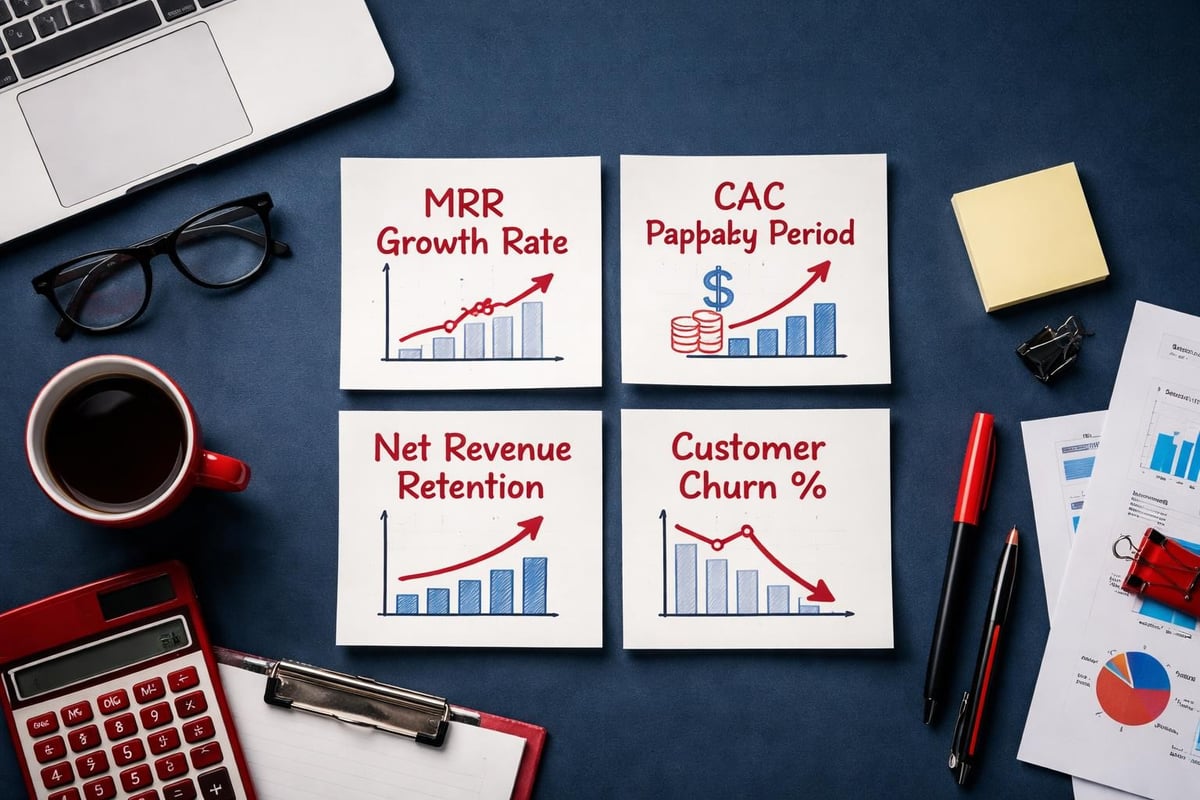
Churn rate represents the percentage of customers who cancel their subscriptions within a given period. A monthly churn rate above 5% signals serious problems with product-market fit or customer success. Reducing churn by just 1-2% can dramatically impact long-term revenue.
The Rule of 40 provides a benchmark for evaluating overall company health by adding revenue growth rate to profit margin. Companies scoring 40% or higher are generally considered strong performers. This framework forces leadership teams to balance growth investments with profitability.
| Metric | Calculation | Target |
|---|---|---|
| Revenue Growth Rate | (Current ARR - Previous ARR) / Previous ARR × 100 | 20%+ |
| Profit Margin | Net Income / Revenue × 100 | 20%+ |
| Combined Score | Growth Rate + Profit Margin | 40%+ |
Companies below this threshold need to evaluate whether they're growing fast enough to justify their burn rate or whether they should shift focus toward profitability. Essential SaaS metrics provide the visibility needed to make these strategic decisions.
Not all customers are created equal. The most profitable saas growth strategies involve identifying high-value customer segments and focusing resources where they generate the greatest return.
Start by analyzing your existing customer base to identify patterns. Which customer profiles have the highest LTV? Which segments have the lowest churn? Which industries or company sizes convert at the highest rates? This analysis reveals where to concentrate acquisition efforts.
Enterprise customers typically require longer sales cycles but deliver significantly higher contract values and lower churn rates. Developing an enterprise expansion strategy requires different processes, sales methodologies, and customer success approaches than selling to small businesses.
Mid-market customers often provide the sweet spot for many SaaS companies. They have budgets to invest in quality solutions but don't require the extensive customization and hand-holding that enterprise accounts demand.
Small business customers can scale quickly through product-led growth motions but typically have higher churn and lower contract values. The key is finding the right balance across segments that aligns with your business model and capabilities.
Sustainable saas growth requires a multi-channel approach to customer acquisition. Relying on a single channel creates vulnerability and limits scaling potential.
Content marketing and SEO provide long-term value by attracting qualified prospects through organic search. This approach requires patience and consistent investment but delivers the lowest CAC over time. Companies that master content marketing build valuable assets that compound in value.
Paid advertising through Google Ads, LinkedIn, and other platforms offers immediate results and predictable scaling. The challenge is maintaining profitable unit economics as competition increases and costs rise. Regular testing and optimization are essential.
Referral programs transform satisfied customers into a growth channel. Growth marketing strategies that leverage customer advocacy can reduce CAC by 50% or more while bringing in highly qualified leads.
Partnership channels create exponential growth opportunities by tapping into established audiences and distribution networks. Strategic partnerships require careful selection and ongoing management but can unlock markets that would otherwise take years to penetrate.
| Channel | CAC | Time to Scale | Long-term Value |
|---|---|---|---|
| Organic/SEO | Low | Slow | Very High |
| Paid Ads | Medium-High | Fast | Medium |
| Referrals | Very Low | Medium | High |
| Partnerships | Low-Medium | Medium | Very High |
Pricing is one of the most powerful levers for accelerating saas growth, yet many companies set prices once and never revisit them. Regular pricing optimization can increase revenue by 20-30% without acquiring a single additional customer.
Value-based pricing aligns what customers pay with the value they receive. This approach requires deep understanding of customer outcomes and willingness to pay. Companies using value-based pricing typically capture 2-3x more revenue than those using cost-plus or competitor-based approaches.
Research on dynamic subscription pricing demonstrates how integrating demand forecasting with churn prediction can optimize both revenue and retention. Advanced pricing strategies consider customer segment, usage patterns, competitive positioning, and market conditions.
Freemium models reduce friction in the acquisition process by allowing prospects to experience the product before committing financially. The challenge is converting enough free users to paid plans to justify the support costs. Successful freemium strategies typically convert 2-5% of free users.
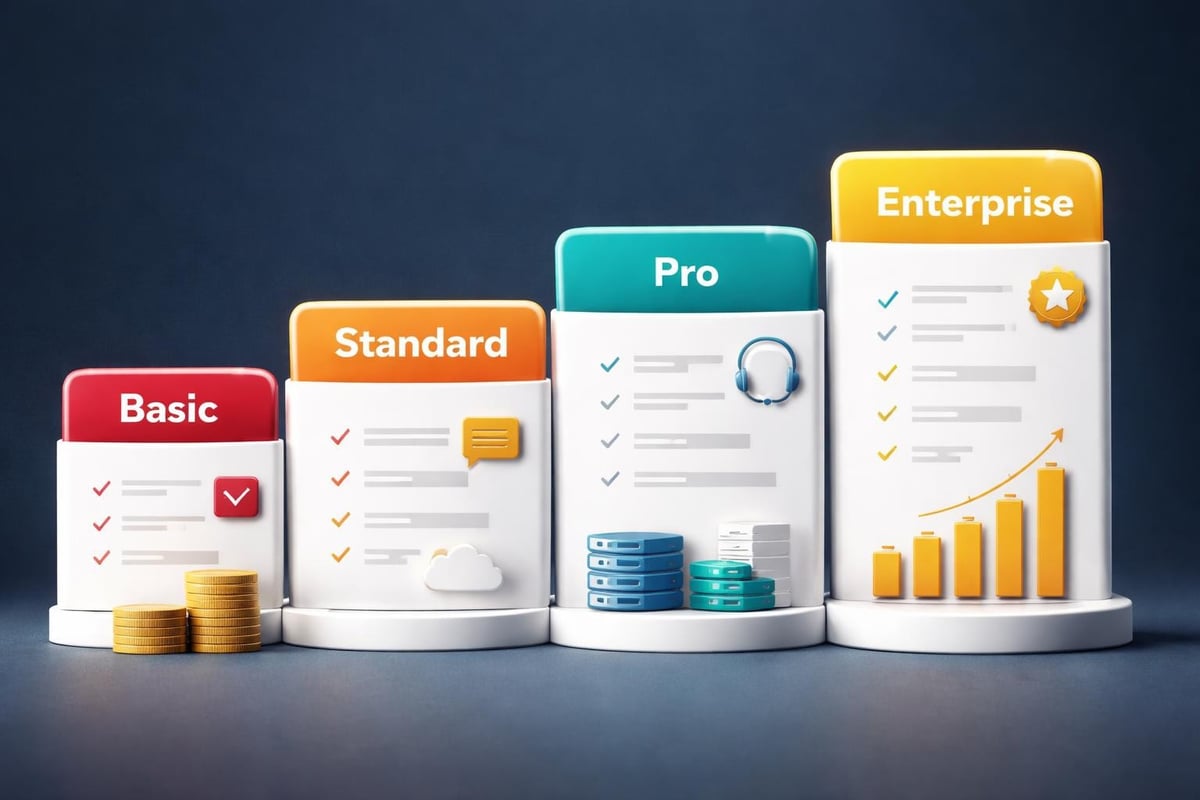
Tiered pricing allows customers to self-select based on their needs and budget. Most successful SaaS companies offer three to four tiers, each serving distinct customer segments. The middle tier typically drives the most volume, while the top tier captures maximum value from power users.
Acquiring new customers costs five to seven times more than retaining existing ones. The most efficient path to saas growth runs through your current customer base.
Proactive customer success programs identify at-risk accounts before they churn. Leading indicators include declining usage, support ticket volume changes, and delayed payments. Intervening early can save 60-70% of at-risk accounts.
Onboarding sets the trajectory for the entire customer relationship. Customers who reach key activation milestones within their first 30 days have 3-5x lower churn rates than those who don't. Structured onboarding programs with clear success milestones dramatically improve retention.
Net Revenue Retention (NRR) measures revenue growth from existing customers after accounting for churn and downgrades. Companies with NRR above 120% can grow sustainably even with zero new customer acquisition. This metric has become increasingly important to investors evaluating SaaS businesses.
Upselling moves customers to higher-value tiers as their needs grow. The best upsell conversations focus on additional value and outcomes rather than features. Timing matters tremendously, with the highest conversion rates occurring immediately after customers achieve significant wins.
Cross-selling introduces customers to complementary products or modules. This strategy works best when additional products solve related problems and integrate seamlessly with what customers already use.
Usage-based expansion automatically grows revenue as customers use more of the product. This model aligns perfectly with customer success because revenue increases only when customers receive more value. Companies like HockeyStack have demonstrated how product-led approaches can drive explosive growth.
Artificial intelligence and automation technologies enable SaaS companies to scale operations without proportionally increasing headcount. These tools improve efficiency across sales, marketing, and customer success functions.
Predictive analytics identify which leads are most likely to convert, allowing sales teams to prioritize high-probability opportunities. Machine learning models can analyze hundreds of data points to score leads with greater accuracy than manual methods.
Automated onboarding sequences guide new customers through initial setup and configuration without human intervention. Well-designed automation can handle 70-80% of onboarding tasks, freeing customer success teams to focus on strategic accounts and complex situations.
Chatbots and AI-powered support tools resolve common customer questions instantly, reducing support ticket volume and improving response times. These systems continuously learn from interactions, becoming more effective over time.
Marketing automation platforms orchestrate complex, multi-channel campaigns that would be impossible to manage manually. These systems track customer behavior across touchpoints and deliver personalized experiences at scale. A comprehensive People and Technology Audit can identify where AI tools can deliver the greatest impact on growth metrics.
Organizational structure and team alignment directly impact a company's ability to execute growth strategies. Many companies hit revenue plateaus because their teams, roles, and processes haven't evolved with the business.
Breaking down silos between sales, marketing, and customer success creates a unified revenue organization. When these teams share goals, data, and accountability, customer experience improves and revenue accelerates. Executives who think like CEOs understand that cross-functional alignment drives sustainable growth.
Revenue Operations (RevOps) emerged as a critical function in high-growth SaaS companies. RevOps teams own the systems, processes, and data that support the entire customer lifecycle. This centralized approach eliminates inefficiencies and ensures consistent execution.
Clear role definitions prevent overlap and gaps in responsibility. As companies scale, specialist roles become necessary in areas like sales development, customer onboarding, renewal management, and expansion sales. The right organizational design supports both efficiency and accountability.
| Growth Stage | Team Structure | Key Roles |
|---|---|---|
| $0-$1M ARR | Generalists | Founder-led sales, Marketing generalist |
| $1M-$5M ARR | Function Specialists | SDRs, AEs, CSMs, Marketing specialists |
| $5M-$20M ARR | Specialized Teams | Enterprise sales, Mid-market sales, RevOps, Growth marketing |
| $20M+ ARR | Segmented Organizations | Vertical teams, Geographic teams, Product-specific teams |
Process documentation ensures consistency as teams grow. New team members can onboard faster, and the organization maintains quality standards regardless of who executes tasks. Regular process reviews identify bottlenecks and opportunities for improvement.
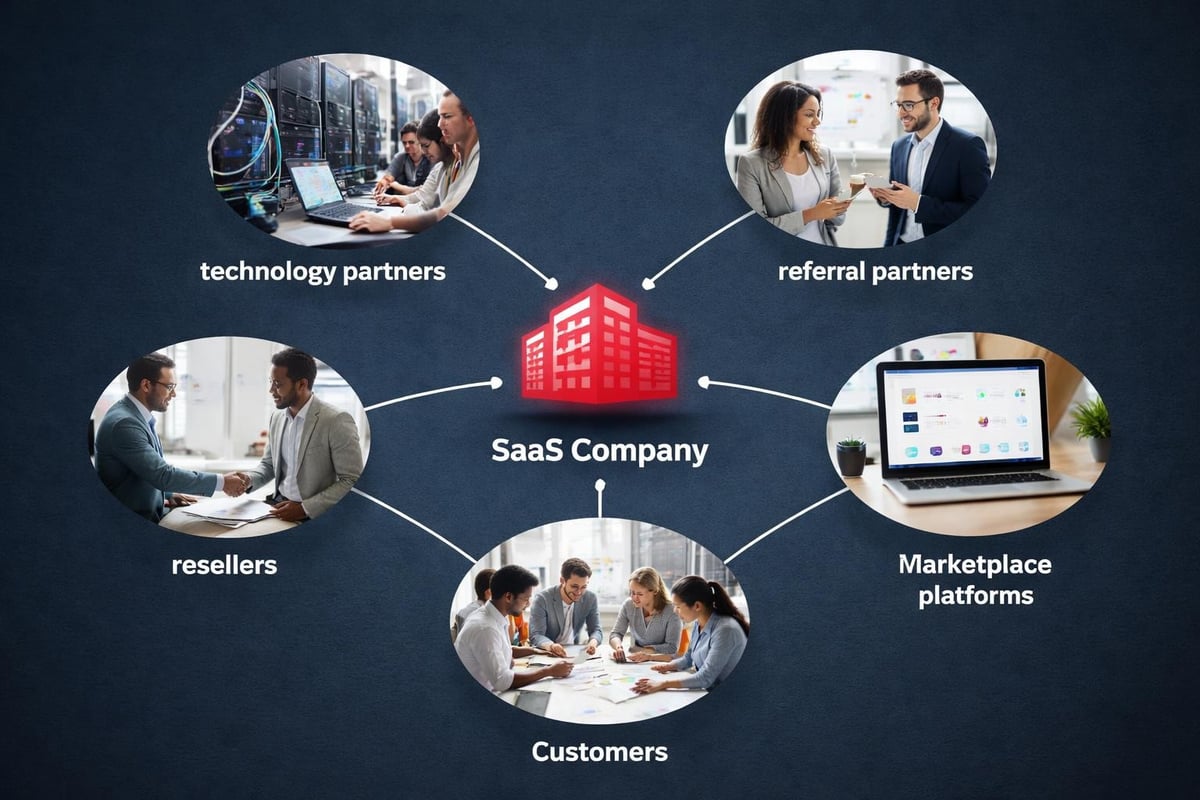
Strategic partnerships accelerate saas growth by providing access to new markets, customer segments, and distribution channels. The right partnerships can add millions in revenue without corresponding increases in customer acquisition costs.
Technology partnerships integrate your product with complementary solutions, creating additional value for customers. These integrations increase stickiness and reduce churn while opening doors to the partner's customer base. Marketplace listings on platforms like Salesforce AppExchange or HubSpot's App Marketplace provide built-in distribution.
Referral partnerships with agencies, consultants, and service providers create ongoing lead flow. These partners recommend your solution to their clients in exchange for commissions or reciprocal referrals. The key is selecting partners whose clients match your ideal customer profile.
Reseller partnerships delegate selling and implementation to third parties who add their services and markup. This model allows rapid geographic expansion without building local teams. Comprehensive growth strategies often include channel development as a key component.
White-label partnerships allow other companies to rebrand and resell your technology. This approach can quickly scale revenue but requires careful consideration of brand implications and support requirements.
Continuous measurement and optimization separate high-growth companies from those that plateau. Establishing a metrics-driven culture ensures every team member understands how their work contributes to overall growth.
Monthly business reviews examine key growth metrics across all functions. These sessions identify trends, celebrate wins, and address challenges before they become critical. Data transparency builds accountability and enables faster decision-making.
Cohort analysis reveals how customer behavior changes over time. Analyzing metrics by cohort (signup month, plan tier, acquisition channel, etc.) uncovers insights that aggregate data masks. Companies often discover that specific cohorts have dramatically different economics, informing future strategy.
A/B testing enables data-driven optimization across the customer journey. Testing pricing, messaging, onboarding flows, and feature sets systematically improves conversion rates and reduces friction. The companies that test most frequently typically grow fastest.
Benchmark data provides context for evaluating performance. While every business is unique, understanding how your metrics compare to industry standards helps identify strengths to leverage and weaknesses to address. Resources on effective SaaS growth strategies provide valuable benchmarks.
Leading indicators predict future performance before lagging indicators reflect results. Pipeline coverage ratios, trial signup trends, and product usage patterns signal what's coming in future quarters. Monitoring leading indicators allows proactive adjustments rather than reactive corrections.
Product-led growth (PLG) uses the product itself as the primary driver of customer acquisition, expansion, and retention. This approach reduces sales and marketing costs while creating viral growth loops.
Free trials and freemium models allow prospects to experience value before purchasing. The product must deliver quick wins during the trial period to drive conversion. Time-to-value becomes the critical metric, with the best PLG companies delivering initial value within minutes or hours.
In-app messaging and prompts guide users toward activation milestones and upgrade opportunities. These contextual nudges feel helpful rather than pushy when designed properly. Usage data informs which messages to show to whom and when.
Viral mechanics encourage users to invite colleagues and collaborators. Collaboration features, sharing capabilities, and network effects naturally expand usage within organizations. Each additional user increases product value and creates expansion opportunities.
Self-service purchasing removes friction from the buying process. Customers can start, upgrade, and expand their subscriptions without speaking to sales representatives. This model requires exceptional product design, clear pricing, and intuitive user experiences.
Sustainable saas growth requires a holistic approach that addresses customer acquisition, retention, expansion, and operational efficiency simultaneously. The strategies outlined here provide a framework for breaking through revenue plateaus and building scalable growth engines. Whether you're stuck at your current revenue level or preparing for your next growth phase, ApetureCodex helps software, services, and manufacturing companies implement these proven strategies through hands-on partnership with your teams, optimizing processes with AI tools and restructuring roles to achieve your revenue goals.