March 2, 2026

Building a successful software-as-a-service company requires more than just a great product idea. SaaS founders face a unique combination of technical, operational, and strategic challenges that can make or break their ventures. From achieving product-market fit to scaling operations efficiently, the path to sustainable growth demands a comprehensive understanding of both technology and business fundamentals. As the SaaS landscape becomes increasingly competitive in 2026, founders must navigate complex decisions around team structure, customer acquisition, retention strategies, and technological infrastructure while maintaining profitability.
The software-as-a-service industry has matured significantly over the past decade, creating both opportunities and obstacles for new entrepreneurs. SaaS founders today enter a market where customer expectations are higher, competition is fiercer, and the cost of customer acquisition continues to rise. Unlike traditional software companies, common challenges SaaS founders face in 2025 include adapting to rapid AI disruption and maintaining competitive advantages through continuous innovation.
Market saturation in many verticals means that differentiation has become critical. Founders can no longer rely solely on being first to market or having superior technology. Instead, they must develop comprehensive go-to-market strategies that address specific customer pain points with measurable ROI.
Many SaaS founders experience rapid initial growth followed by unexpected plateaus. These stagnation points typically occur at predictable revenue milestones where existing processes and team structures no longer support additional scale.
Common plateau triggers include:
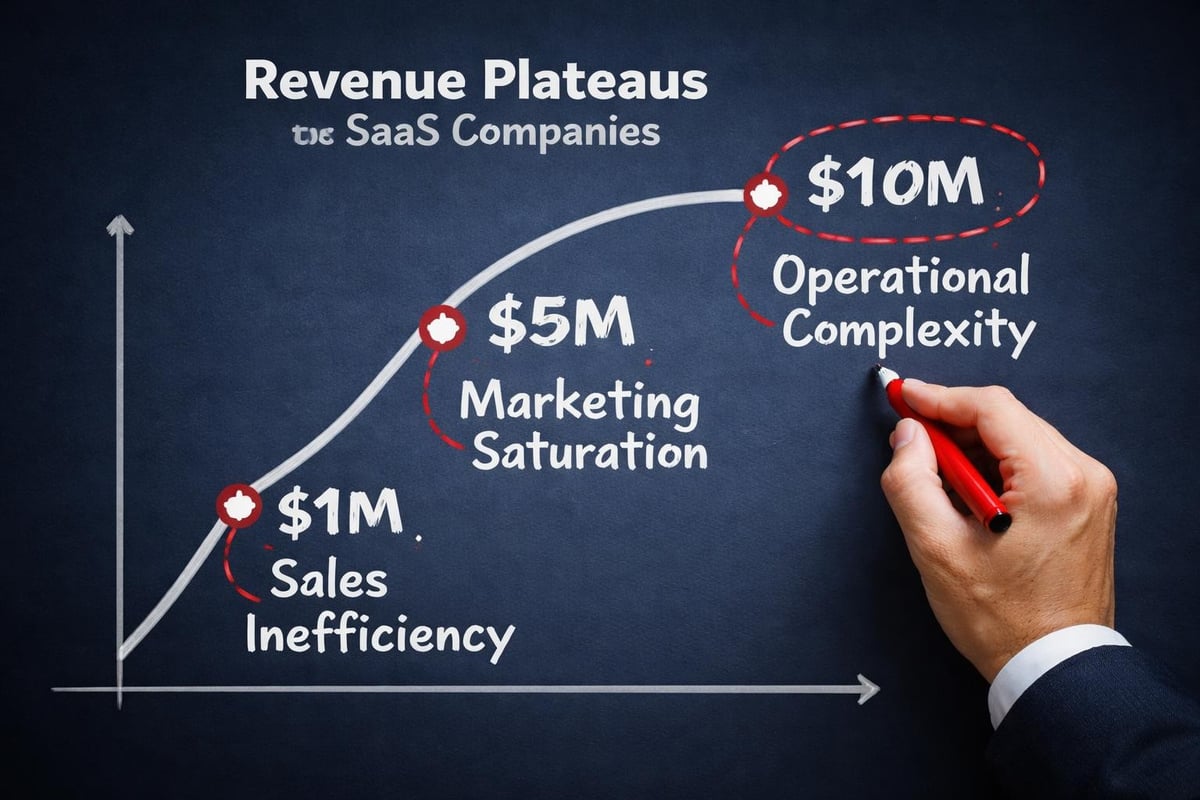
Breaking through these plateaus requires systematic evaluation of people, processes, and technology. SaaS founders who successfully navigate these transitions typically invest in strategic audits that identify specific bottlenecks before implementing targeted improvements.
Revenue growth for SaaS companies depends on optimizing three critical levers: customer acquisition, expansion revenue, and retention. SaaS founders must develop sophisticated understanding of unit economics while building systems that support consistent, predictable growth.
The customer acquisition cost (CAC) to lifetime value (LTV) ratio serves as a fundamental metric for sustainable growth. However, many founders focus exclusively on reducing CAC without adequately investing in retention and expansion strategies that increase LTV.
Early-stage sales often rely on founder-led selling, which creates unique advantages through deep product knowledge and authentic customer relationships. As companies scale, SaaS founders must transition to repeatable sales processes that new team members can execute effectively.
| Growth Stage | Sales Approach | Key Focus Areas | Common Challenges |
|---|---|---|---|
| 0-$1M ARR | Founder-led | Product-market fit, initial customers | Inconsistent messaging, lack of process |
| $1M-$5M ARR | Hybrid team | Process documentation, hiring | Role clarity, maintaining quality |
| $5M-$20M ARR | Specialized team | Territory management, specialization | Coordination, training at scale |
| $20M+ ARR | Enterprise motion | Strategic accounts, partnerships | Complexity, longer sales cycles |
A comprehensive Sales Strategy service can help SaaS founders identify gaps in their current approach and implement systematic improvements that drive consistent revenue growth. This involves evaluating sales methodologies, compensation structures, territory design, and technology stack to ensure alignment with growth objectives.
Successful SaaS founders recognize that why SaaS startups fail often traces back to inadequate sales fundamentals and poor team cohesion rather than product deficiencies.
While acquisition receives considerable attention, retention determines long-term viability for subscription businesses. SaaS founders must build customer success operations that proactively prevent churn while identifying expansion opportunities.
The high customer churn rates that plague many SaaS businesses stem from misalignment between product value and customer expectations. Addressing this requires systematic onboarding, ongoing engagement, and continuous value demonstration.
Net Revenue Retention (NRR) has emerged as the definitive metric for SaaS health, reflecting both churn and expansion in a single number. SaaS founders should target NRR above 110% to demonstrate strong product-market fit and expansion potential.
Critical retention indicators:
Implementing data-driven customer success requires investing in analytics infrastructure and training teams to interpret signals correctly. Many SaaS founders struggle with this transition from reactive support to proactive success management.
Beyond operational metrics, SaaS founders face personal and strategic challenges that impact company trajectory. Funding and cash flow issues particularly affect young entrepreneurs who may lack experience managing complex financial dynamics inherent to subscription models.
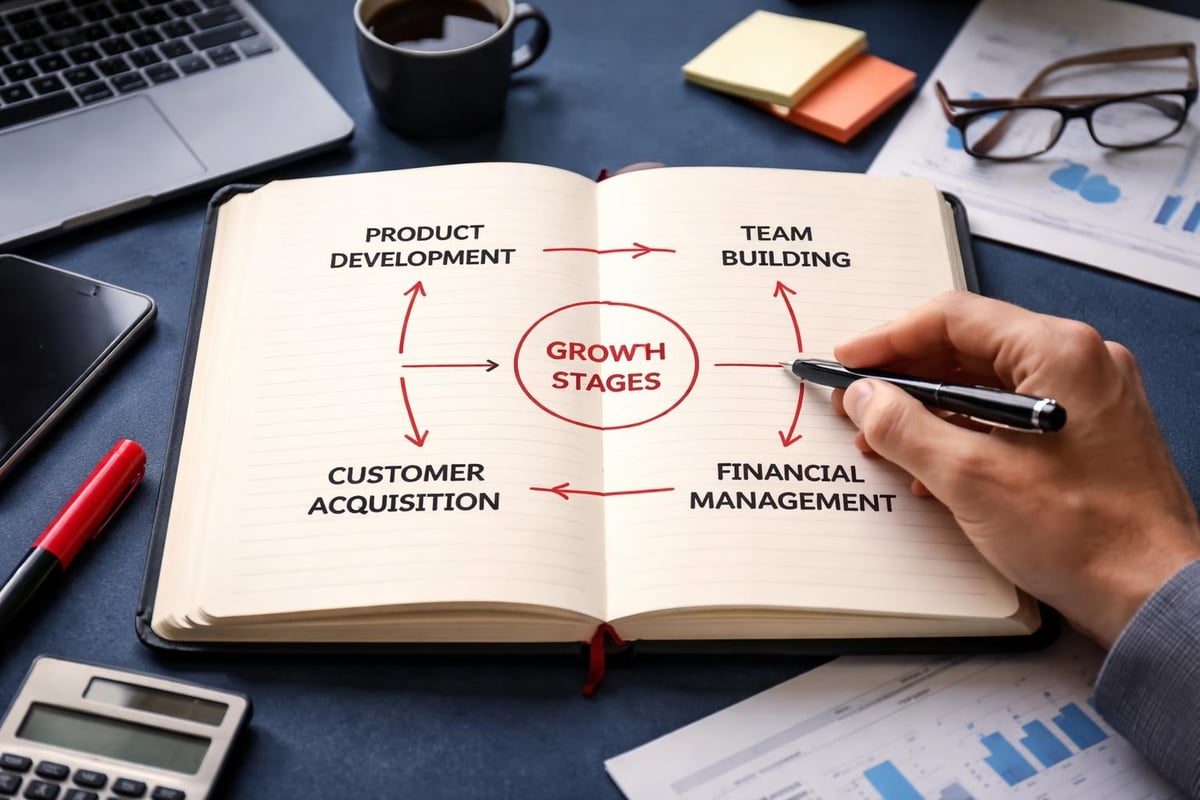
Hiring represents one of the most consequential decisions for SaaS founders. Each new team member changes company culture and capabilities while increasing fixed costs that impact runway and profitability.
The temptation to hire for immediate needs rather than future requirements often creates organizational debt that becomes expensive to remedy. Founders should design roles with clear accountability and growth pathways that support scaling.
Effective team scaling principles:
Understanding poor product-market fit and scaling issues helps founders avoid premature scaling that consumes resources without generating proportional returns.
The 2026 landscape demands that SaaS founders think critically about technology infrastructure and AI integration. While AI tools offer tremendous potential for operational efficiency, implementation requires strategic thinking about where automation adds genuine value.
Many founders fall into the trap of adopting technology for its own sake rather than solving specific business problems. Effective technology decisions start with process clarity, then identify tools that enhance or automate those processes.
AI and automation tools can significantly impact SaaS operations across multiple functions. Customer support benefits from intelligent routing and response suggestions. Sales teams gain efficiency through automated data entry and lead scoring. Marketing operations improve through predictive analytics and personalization engines.
| Function | AI Application | Efficiency Gain | Implementation Complexity |
|---|---|---|---|
| Customer Support | Chatbots, ticket routing | 30-40% | Low-Medium |
| Sales | Lead scoring, outreach automation | 20-30% | Medium |
| Marketing | Personalization, content generation | 25-35% | Medium-High |
| Product | Usage analytics, feature recommendations | 15-25% | High |
However, SaaS founders must balance automation with maintaining human touchpoints that build relationships and gather qualitative insights. Over-automation can create efficiency while damaging customer experience and market understanding.
Beyond direct sales and marketing, partnerships represent an underutilized growth channel for many SaaS founders. Strategic alliances can provide distribution, credibility, and feature integration that accelerates customer acquisition and retention.
Successful partnership strategies require identifying complementary solutions that serve similar customer bases without direct competition. Technology partnerships, referral programs, and channel relationships each serve different purposes in a comprehensive growth strategy.
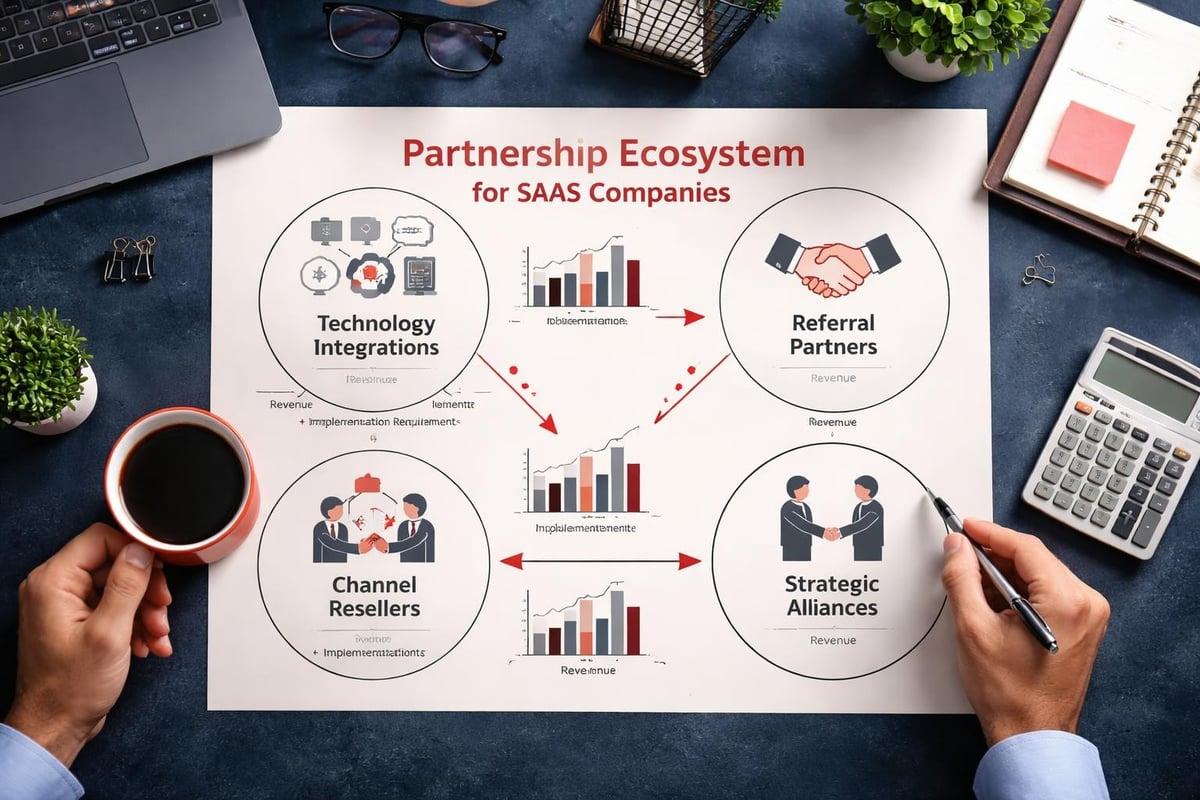
Rather than pursuing partnerships opportunistically, effective SaaS founders develop systematic frameworks for evaluating, launching, and managing partner relationships. This includes clear criteria for partner selection, structured onboarding processes, and ongoing performance measurement.
Partnership success requires dedicated resources and executive sponsorship. Founders often underestimate the effort required to make partnerships productive, leading to initiatives that consume time without generating results.
Sustainable growth for SaaS companies requires disciplined financial management beyond basic bookkeeping. SaaS founders must understand cohort economics, payback periods, and cash flow dynamics unique to subscription models.
The gap between bookings, billings, and revenue creates complexity that catches many founders unprepared. Annual contracts may improve cash flow but create revenue recognition challenges. Monthly billing provides flexibility but increases payment processing costs and potential churn points.
Essential metrics every SaaS founder should monitor:
Understanding these metrics enables data-driven decisions about investment priorities and growth strategies. SaaS founders who master financial analytics gain significant competitive advantages through smarter capital allocation.
As data privacy and security concerns intensify globally, SaaS founders must prioritize robust security measures and compliance frameworks. Customer trust depends on demonstrated commitment to protecting sensitive information.
The cost and complexity of security compliance has increased significantly, particularly for companies serving enterprise customers or operating in regulated industries. SOC 2, GDPR, HIPAA, and other frameworks require substantial investment in infrastructure, processes, and ongoing audits.
Early-stage SaaS founders face difficult decisions about security investment timing. Delaying compliance work can limit enterprise sales opportunities, while premature investment diverts resources from product development and customer acquisition.
A pragmatic approach involves implementing security fundamentals from inception while planning systematic enhancement aligned with customer requirements and revenue milestones. This includes encryption standards, access controls, audit logging, and incident response procedures.
The limitations of traditional SaaS models have prompted some founders to explore hybrid approaches combining subscription software with services, marketplaces, or open-source foundations. Market evolution requires ongoing assessment of business model viability.
Competitive pressure continues intensifying across most SaaS categories. Founders must develop sustainable differentiation through superior product capabilities, exceptional customer experience, or specialized vertical focus. Generic horizontal solutions face increasing challenges against specialized alternatives.
Continuous innovation separates thriving SaaS companies from those that stagnate. However, innovation must balance new capability development with core product stability and user experience consistency. Many SaaS founders struggle with feature prioritization as customer requests multiply.
Effective product strategy requires disciplined roadmap management informed by usage data, customer feedback, competitive analysis, and market trends. Building features customers request isn't always the right answer when those requests conflict with broader strategic direction.
Studying both successful companies and why SaaS startups fail provides valuable insights for founders navigating their own journeys. Common failure patterns include premature scaling, founder conflicts, and inadequate market validation before significant investment.
Conversely, lessons from explosive growth stories demonstrate the power of focused execution, clear differentiation, and strategic resource allocation. Successful SaaS founders typically excel at a few critical capabilities rather than achieving mediocrity across all dimensions.
The ability to learn quickly from market feedback and adjust strategies accordingly separates founders who break through from those who persist with failing approaches. This requires intellectual honesty about what's working and willingness to make difficult changes when evidence demands them.
While growth metrics dominate startup conversations, sustainable SaaS businesses require foundations that support long-term profitability and market leadership. This includes building defensible competitive moats, developing organizational capabilities, and establishing brand recognition.
SaaS founders should think beyond the next funding round toward the business they're building for the next decade. This perspective influences decisions about technology architecture, market positioning, team development, and partnership strategies. Short-term optimization can create long-term constraints that limit future options.
Successfully scaling a SaaS company requires balancing multiple competing priorities while maintaining focus on sustainable revenue growth and operational efficiency. The challenges facing SaaS founders today demand strategic thinking across sales, marketing, customer success, partnerships, and technology infrastructure. When you're ready to break through revenue plateaus and build systematic growth engines, ApetureCodex can help identify the specific bottlenecks limiting your growth and implement proven strategies to achieve your revenue objectives. Our hands-on approach works alongside your team to transform processes, optimize roles, and leverage AI tools where they deliver measurable improvements.


If you’re like many SaaS founders, you expected growth to accelerate once you found traction. Instead, you’re hitting unexpected roadblocks—technical bottlenecks, scaling challenges, churn issues, and hiring struggles. And the worst part? You don’t know who to turn to for help.