March 12, 2026

Every organization reaches critical inflection points where simply maintaining the status quo no longer delivers results. Stagnant revenue, declining market share, or operational inefficiencies signal that fundamental business needs require attention. Understanding and addressing these needs separates thriving companies from those perpetually struggling to break through growth barriers. For start-ups and legacy businesses alike, the ability to identify, prioritize, and solve core business needs determines long-term viability and competitive advantage in today's rapidly evolving marketplace.
Business needs represent the gap between current organizational performance and desired outcomes. These needs emerge from market pressures, customer expectations, internal inefficiencies, or strategic ambitions that current capabilities cannot fulfill. Clearly defining business needs ensures project success and stakeholder alignment across the organization.
Identifying these needs requires systematic examination of multiple organizational dimensions. Revenue plateaus often stem from misaligned sales processes, inadequate marketing reach, or untapped customer opportunities rather than external market conditions alone.
Organizations face business needs originating from various internal and external factors:
Understanding where business needs originate helps prioritize solutions and allocate resources effectively. A software company experiencing revenue stagnation might discover its primary business need involves customer retention rather than new acquisition, fundamentally shifting strategic focus.

Successful organizations employ structured methodologies to uncover and validate their business needs. Business needs analysis minimizes implementation risks and prevents cost overruns by establishing clear objectives before pursuing solutions.
The identification process begins with comprehensive stakeholder engagement. Sales teams provide frontline insights into customer objections and competitive disadvantages. Marketing departments reveal messaging gaps and market positioning challenges. Customer success teams identify recurring pain points and expansion opportunities. This cross-functional perspective prevents siloed thinking that overlooks systemic issues.
Quantitative analysis reveals patterns that qualitative assessments might miss:
Manufacturing companies frequently discover business needs through production data showing quality inconsistencies or capacity constraints. Service organizations might identify needs through customer satisfaction scores correlating with specific operational processes.
| Analysis Type | Primary Focus | Key Metrics | Typical Findings |
|---|---|---|---|
| Revenue | Growth patterns | MRR, ARR, growth rate | Segment-specific stagnation |
| Customer | Behavior trends | Churn, NPS, CSAT | Retention opportunities |
| Operations | Efficiency | Cycle time, error rates | Process bottlenecks |
| Market | Competitive position | Market share, win rates | Positioning gaps |
Organizations often benefit from external perspectives when conducting this analysis. A comprehensive People and Technology Audit examines both human capabilities and technological infrastructure to determine where strategic improvements create the greatest impact on revenue growth.
Identifying business needs represents only the first step. Translating needs into solutions requires defining specific requirements and design parameters that address root causes rather than symptoms.
This translation process demands precision and stakeholder alignment. Vague business needs like "increase revenue" lack the specificity required for effective solution design. Refined statements such as "expand enterprise customer segment revenue by 40% within 18 months through dedicated sales team and partner channel development" provide clear direction.
Effective requirements possess specific characteristics:
Software companies transitioning from product-led to sales-led growth exemplify this translation challenge. The business need for enterprise market penetration spawns requirements spanning sales team structure, compensation models, marketing positioning, product features, and customer success capabilities. Each requirement must trace directly back to the overarching need while remaining independently actionable.
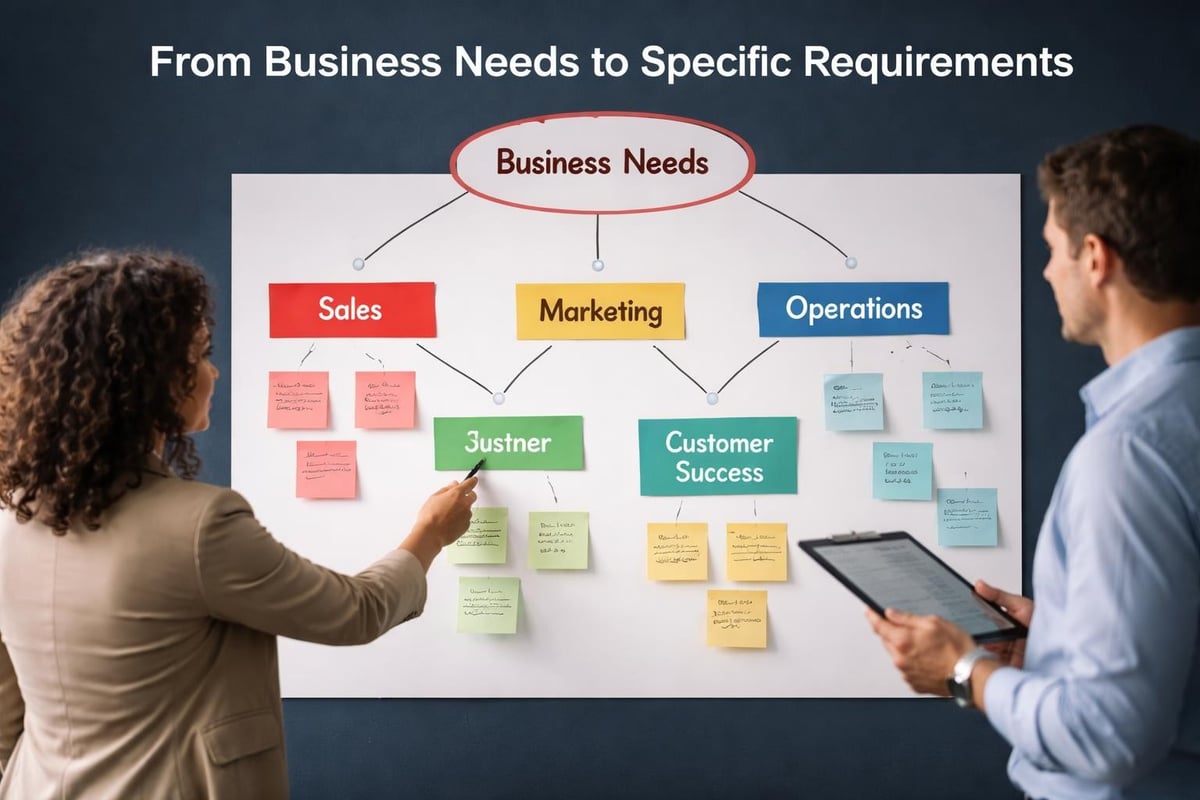
Organizations rarely face single, isolated business needs. Multiple pressures compete for attention and resources simultaneously. Manufacturing firms might simultaneously address production efficiency, market expansion, and workforce development. Software companies often balance product innovation, sales scaling, and customer retention.
Prioritization frameworks help navigate these competing demands. The impact-effort matrix plots business needs against two dimensions: potential impact on revenue and organizational effort required. High-impact, low-effort needs receive immediate attention while low-impact, high-effort initiatives face deferral or elimination.
Beyond simple impact-effort analysis, sophisticated prioritization considers:
Legacy businesses often struggle with prioritization because historical success creates organizational attachment to outdated approaches. A manufacturing company might resist addressing sales process modernization needs because traditional relationship-based selling previously delivered results, even when data clearly shows diminishing returns.
| Priority Level | Impact | Effort | Typical Timeline | Examples |
|---|---|---|---|---|
| Critical | High | Variable | 0-3 months | Revenue-blocking issues |
| Strategic | High | High | 6-12 months | Market expansion initiatives |
| Tactical | Medium | Low | 1-3 months | Process optimizations |
| Deferred | Low | High | 12+ months | Nice-to-have capabilities |
Understanding how executives think strategically about prioritization helps teams align business needs with board-level expectations and secure necessary investment for critical initiatives.
Addressing business needs often requires organizational restructuring beyond simply deploying new tools or processes. The relationship between team structure, role clarity, and business outcomes proves consistently significant across industries.
Service organizations frequently discover that business needs around customer retention trace to unclear ownership between sales and customer success functions. Manufacturing companies might find quality improvement needs hampered by siloed communication between production and design teams.
Effective organizational design addresses business needs through:
Software companies scaling from founder-led sales to professional sales organizations exemplify structural business needs. The transition requires defining sales roles, establishing territories, creating compensation structures, and implementing management layers that didn't previously exist. Each structural element directly supports the business need for predictable, scalable revenue growth.
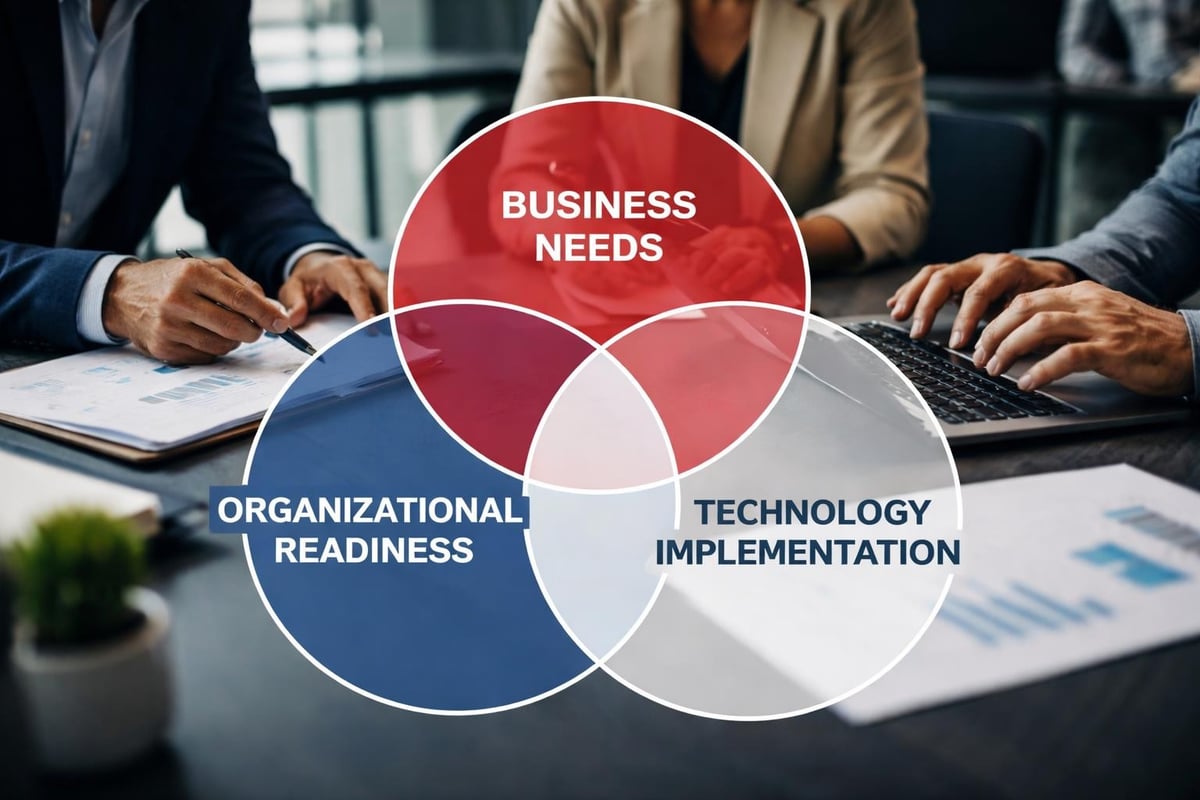
Modern business needs frequently involve technology considerations, though technology alone rarely constitutes the complete solution. Artificial intelligence, automation, and data analytics tools enable capabilities that manual processes cannot match, but their effectiveness depends on proper implementation within sound strategic frameworks.
Comprehensive business analysis examines how technology intersects with people, processes, and objectives to create sustainable competitive advantages. Organizations pursuing business needs related to operational efficiency increasingly leverage AI tools for data analysis, customer communication, and process automation.
Aligning technology with business needs requires evaluating:
Start-ups often face business needs that technology can partially address while organizational maturity remains the primary constraint. A growing software company might implement a sophisticated CRM system to support sales scaling needs, but without proper sales processes, role clarity, and management discipline, the technology delivers minimal value.
Addressing business needs requires clear success metrics established before solution implementation. Without measurement frameworks, organizations cannot definitively determine whether initiatives actually resolved the underlying needs or simply consumed resources without meaningful impact.
Effective measurement begins during the needs identification phase. Each business need should have associated baseline metrics, target outcomes, and interim milestones. A manufacturing company addressing production efficiency needs might track defect rates, cycle times, and per-unit costs. Service organizations tackling customer retention needs monitor churn rates, renewal percentages, and expansion revenue.
Robust measurement spans multiple dimensions:
Templates for needs analysis help structure this measurement process, ensuring comprehensive evaluation of company performance and growth areas. These frameworks prevent organizations from declaring success based on activity completion rather than outcome achievement.
Organizations frequently stumble when addressing business needs, despite good intentions and adequate resources. Understanding common failure patterns helps avoid predictable mistakes that undermine even well-conceived initiatives.
The most prevalent pitfall involves confusing solutions with needs. Stating "we need a new CRM system" identifies a potential solution rather than the underlying business need the system might address. Proper needs statements focus on outcomes: "we need to reduce customer acquisition costs by 25% through improved lead management and sales process efficiency."
Organizations should guard against:
Legacy businesses particularly struggle with change resistance when addressing business needs. Established processes and relationships create organizational inertia that persists even when data clearly demonstrates the need for transformation. Overcoming this resistance requires transparent communication about market realities and competitive threats.
Business needs never remain static. Market conditions, competitive landscapes, and customer expectations continually evolve, creating new needs while rendering previously critical needs obsolete. Organizations must build adaptive capacity into their strategic planning processes.
Software companies face particularly rapid evolution of business needs due to technology disruption and changing buyer preferences. Understanding how successful companies adapt provides valuable insights for managing this constant change. What constitutes a competitive advantage today may become table stakes tomorrow.
Organizations sustain relevance through:
Manufacturing companies transitioning toward service-based business models exemplify evolving business needs. Initial needs focus on developing service capabilities and pricing models. As the transition progresses, needs shift toward service delivery optimization, customer success management, and recurring revenue forecasting. Each phase presents distinct challenges requiring different organizational responses.
Comprehensive business needs rarely confine themselves to single departments or functions. Revenue growth needs span sales, marketing, customer success, product development, and operations. Addressing these needs requires cross-functional integration and collaborative problem-solving.
Siloed approaches inevitably create suboptimal outcomes. A sales team addressing revenue growth needs through aggressive discounting might undermine profitability goals. Marketing campaigns targeting volume without considering sales capacity create fulfillment problems. Customer success initiatives promising capabilities that product teams cannot deliver damage credibility and retention.
| Function | Primary Focus | Common Needs | Integration Points |
|---|---|---|---|
| Sales | Revenue generation | Pipeline development, conversion rates | Marketing, customer success, product |
| Marketing | Demand creation | Lead quality, brand positioning | Sales, partnerships, product |
| Customer Success | Retention and expansion | Churn reduction, upsell rates | Sales, product, operations |
| Operations | Efficiency | Cost reduction, quality improvement | All customer-facing functions |
Understanding business model alignment helps visualize how different organizational elements must work together to address comprehensive business needs. This systems thinking prevents localized optimization that creates problems elsewhere.
Organizations struggling with persistent business needs often benefit from external perspectives. Internal teams develop blind spots through familiarity and may lack exposure to innovative approaches emerging in other industries or markets. Third-party expertise provides fresh insights and proven methodologies for addressing complex challenges.
This external engagement proves particularly valuable when organizations lack internal capabilities for specialized analysis or transformation. A manufacturing company addressing digital transformation needs might not employ staff with relevant software industry experience. A software start-up scaling sales lacks the battle-tested processes that enterprise sales veterans take for granted.
Successful external engagement requires clear scope definition and collaborative partnership rather than passive delegation. Organizations must remain actively involved in needs assessment, solution design, and implementation to build internal capacity for sustained improvement.
Addressing business needs represents the foundation of sustainable growth and competitive advantage. Organizations that systematically identify needs, prioritize effectively, and implement comprehensive solutions position themselves for breakthrough performance. Whether your business faces revenue plateaus, operational inefficiencies, or market disruption challenges, understanding and addressing core business needs creates the pathway forward. ApetureCodex specializes in helping start-ups and legacy businesses break through growth barriers by addressing fundamental business needs across sales, marketing, customer success, and partnerships, combining strategic insight with hands-on implementation support to deliver measurable revenue improvements.