February 28, 2026
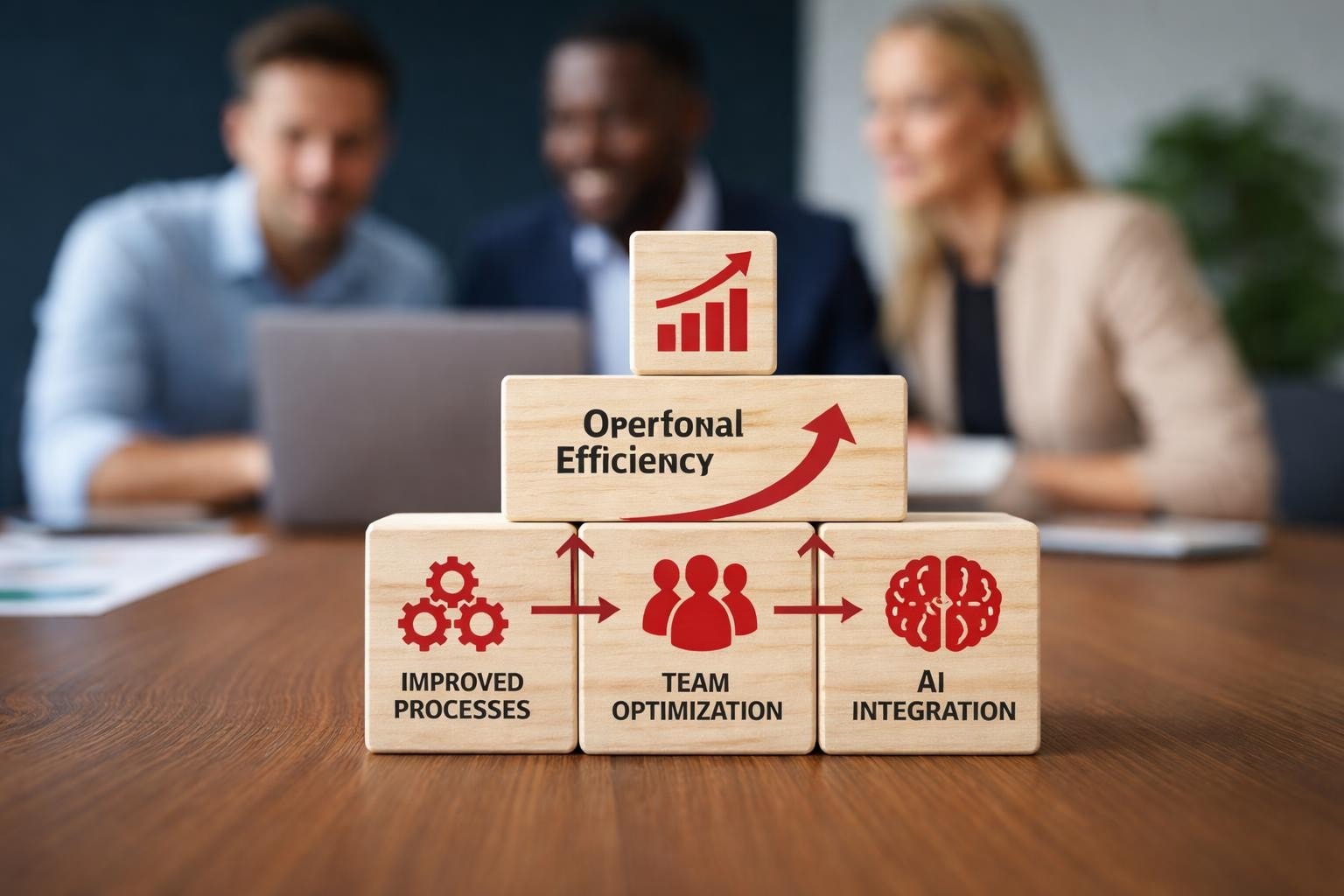
Many businesses reach a point where growth stalls, revenue plateaus, and traditional approaches no longer deliver results. For start-ups and legacy companies alike, the answer often lies not in working harder but in restructuring how work gets done. When you streamline operations across your organization, you create the foundation for sustainable revenue growth by eliminating bottlenecks, optimizing resources, and empowering teams to focus on high-impact activities that drive business outcomes.
The connection between operational efficiency and revenue growth isn't always obvious, but it's fundamental. When processes are convoluted, teams spend valuable time navigating internal obstacles rather than serving customers or closing deals. This hidden friction drains profitability and limits your ability to scale.
Operational inefficiencies manifest in several ways:
Companies that streamline operations effectively can reallocate resources toward growth initiatives. A sales team freed from administrative burden can pursue more prospects. A customer success team with better data access can identify upsell opportunities faster. A manufacturing operation with optimized workflows can increase output without proportional cost increases.

Every unnecessary step in your processes carries a cost. These costs accumulate across your organization, creating a drag on performance that becomes harder to overcome as you grow. Research from Stanford's examination of operational logistics demonstrates how even seemingly small improvements in backend operations can transform business models.
Consider the typical software company stuck at a specific revenue threshold. Their sales cycle might involve multiple handoffs between marketing, sales development, account executives, and implementation teams. Each handoff introduces potential delays, miscommunication, and lost context. When you streamline operations in this scenario, you might discover that consolidating roles or implementing better CRM workflows reduces the sales cycle by 20%, directly impacting revenue velocity.
Manufacturing companies face similar challenges. Legacy processes designed for different production volumes or product lines create inefficiencies that compound over time. The key is identifying which processes genuinely add value and which exist simply because "we've always done it this way."
Before implementing changes, you need a clear picture of your current state. A comprehensive operational audit reveals where inefficiencies hide and which improvements will deliver the greatest return. This diagnostic phase separates successful transformations from well-intentioned efforts that fail to move the needle.
Start by documenting how value flows through your organization from initial customer contact through delivery and ongoing service. This value stream mapping exercise often reveals surprising insights about where time and resources disappear.
| Process Area | Common Inefficiencies | Revenue Impact |
|---|---|---|
| Lead Generation | Unqualified leads, poor targeting | Wasted sales capacity |
| Sales Process | Manual data entry, approval delays | Extended sales cycles |
| Customer Onboarding | Inconsistent process, knowledge gaps | Higher churn rates |
| Service Delivery | Rework, unclear specifications | Reduced margins |
| Customer Success | Reactive approach, limited data | Missed expansion opportunities |
For service businesses, the value stream might reveal that project kickoffs consistently take longer than necessary because information gathered during sales isn't properly transferred to delivery teams. This gap not only delays revenue recognition but also creates customer frustration that impacts retention and referrals.
Modern businesses generate enormous amounts of operational data, but most don't use it effectively. AI-enhanced business process automation is transforming how companies identify and address operational inefficiencies, using machine learning to detect patterns human observers might miss.
Your existing systems contain valuable insights about where to streamline operations. CRM data reveals sales process bottlenecks. Project management tools show where timelines consistently slip. Customer service platforms highlight recurring issues that suggest underlying process problems. The challenge is synthesizing this information into actionable intelligence.
A People and Technology Audit examines both your team structure and your technology stack to identify misalignments and opportunities. Often, businesses invest in powerful tools but use only a fraction of their capabilities, while simultaneously maintaining manual processes that could be automated. Other times, role definitions haven't evolved with the business, creating gaps or overlaps that reduce efficiency.
Once you've identified opportunities, implementation becomes critical. Many transformation efforts fail not from poor strategy but from inadequate execution. Successfully streamlining operations requires a structured approach that balances quick wins with sustainable long-term change.
Not all operational improvements are created equal. Some deliver immediate revenue impact while others provide foundational capabilities for future growth. Create a prioritization framework that considers both business impact and implementation difficulty.
High-priority improvements typically share these characteristics:
For example, automating proposal generation for a sales team might rank highly because it reduces response time (impacting win rates), saves hours per week (increasing capacity), and can be implemented quickly with available tools. Contrast this with a complete CRM replacement, which might ultimately be necessary but requires extensive planning, training, and change management.

Operational silos are among the most stubborn obstacles to efficiency. When departments optimize their processes in isolation, they often create problems elsewhere in the organization. To truly streamline operations, you need cross-functional collaboration and shared objectives.
Strategies for enhancing operational efficiency emphasize the importance of breaking down departmental barriers and creating integrated workflows. This might mean restructuring teams, redefining roles, or implementing shared technology platforms that give everyone visibility into the end-to-end process.
Consider a manufacturing company where production scheduling, procurement, and quality assurance operate independently. Production might optimize for maximum throughput while procurement focuses on minimizing inventory costs and quality assurance prioritizes zero defects. Each goal is valid, but optimizing them separately creates conflicts. A cross-functional approach identifies the optimal balance that maximizes overall business performance.
Technology has always played a role in operational efficiency, but artificial intelligence is fundamentally changing what's possible. Modern AI tools can handle complex tasks that previously required human judgment, freeing your team to focus on strategic activities that drive revenue growth.
The key to successful automation isn't eliminating humans but augmenting their capabilities. Identify tasks that are repetitive, rules-based, or data-intensive as primary automation candidates. Robotic process automation and communication tools can handle these activities with greater speed and consistency than manual processes.
Prime automation candidates include:
For software companies, AI can dramatically streamline operations in customer success. Machine learning models can analyze usage patterns to predict churn risk, identify expansion opportunities, and trigger proactive outreach at optimal times. This transforms customer success from a reactive function into a revenue-driving engine.
While AI offers tremendous potential, implementation requires careful planning. Start with specific use cases where you can demonstrate clear value, then expand based on results and learning. According to proven strategies for business efficiency, successful technology adoption focuses on solving real business problems rather than implementing technology for its own sake.
Many businesses rush to adopt AI without adequate preparation, resulting in disappointing outcomes. Before implementing AI tools, ensure you have clean data, well-defined processes, and clear success metrics. The most sophisticated AI model can't overcome poor data quality or unclear objectives.
| AI Application | Business Function | Efficiency Gain | Revenue Impact |
|---|---|---|---|
| Lead Scoring | Marketing/Sales | 40% time savings | 15% win rate improvement |
| Chatbots | Customer Service | 60% ticket reduction | Higher satisfaction scores |
| Predictive Analytics | Customer Success | 30% faster identification | 25% increase in expansions |
| Process Mining | Operations | 50% faster diagnosis | 20% cycle time reduction |
Process and technology improvements only deliver results when aligned with how your teams are structured and how roles are defined. Many organizations discover that outdated organizational structures prevent them from fully realizing efficiency gains.
The traditional functional hierarchy made sense in an era of stable markets and predictable growth. Today's business environment demands more flexibility and faster decision-making. When you streamline operations, consider whether your organizational structure supports or hinders efficiency.
Flatter structures with clear accountability often outperform deep hierarchies with multiple approval layers. Cross-functional teams organized around customer segments or product lines can move faster than siloed departments. The optimal structure depends on your specific business, but the principle remains constant: design your organization to minimize handoffs and maximize ownership.
Essential approaches for operations executives highlight the importance of involving employees in process improvement initiatives. Those closest to the work often have the best insights about inefficiencies and practical solutions. Creating mechanisms for bottom-up innovation accelerates improvement efforts and builds organizational buy-in.
Role clarity is fundamental to operational efficiency, yet many businesses operate with vague or outdated job descriptions. When responsibilities overlap or gaps exist, work falls through cracks or gets duplicated. Clear role definition, combined with appropriate decision-making authority, enables teams to move faster and make better choices.
For service businesses, consider whether your client-facing roles have evolved with your offerings. A consultative sales approach requires different skills than transactional selling. Customer success managers need analytical capabilities if you expect them to identify expansion opportunities. Ensure role definitions reflect what you actually need from people, not what made sense when the roles were created.

Improvement initiatives often start strong but fade as daily pressures reassert themselves. Sustainable transformation requires ongoing measurement, accountability, and continuous refinement. The businesses that successfully streamline operations treat efficiency as an ongoing practice, not a one-time project.
What gets measured gets managed, but measuring the wrong things drives counterproductive behavior. Choose metrics that directly connect to business outcomes rather than activity-based measures that create the illusion of progress.
Effective operational metrics include:
These metrics tell you whether your improvements actually translate into better business performance. Track them consistently and review them regularly with your leadership team. Key steps to streamlining operations emphasize the importance of regular process reviews and continuous monitoring to sustain improvements over time.
The most successful companies embed efficiency into their culture rather than treating it as an initiative with a start and end date. This means empowering teams to identify and solve problems, celebrating process improvements alongside business wins, and making operational excellence a leadership priority.
Building a culture of efficiency requires consistent reinforcement from leadership. When executives demonstrate that they value efficiency through their actions and decisions, teams follow suit. This might mean protecting time for process improvement work, rewarding innovative solutions to operational challenges, or making efficiency metrics part of performance discussions.
Regular retrospectives or process review sessions keep improvement top of mind. These don't need to be elaborate; even brief weekly check-ins where teams discuss what's working and what isn't can surface valuable insights. The key is consistency and genuine commitment to acting on what you learn.
Ultimately, the goal of streamlining operations isn't efficiency for its own sake but creating the foundation for sustainable revenue growth. Every operational improvement should connect back to your growth strategy, enabling you to acquire more customers, serve them better, or expand relationships more effectively.
Make the connection between operational efficiency and revenue explicit in your organization. When proposing process changes, articulate the revenue impact. When celebrating efficiency wins, highlight how they contribute to growth objectives. This focus keeps improvement efforts aligned with business priorities and builds support for ongoing investment.
For software companies pursuing expansion revenue, streamlined customer success operations directly enable growth. Efficient onboarding gets customers to value faster, improving retention. Systematic health monitoring identifies at-risk accounts before churn occurs. Proactive expansion conversations based on usage data increase average contract values. Each operational improvement compounds into significant revenue impact. Learning from successful companies like HockeyStack's growth strategies can provide valuable insights into connecting operational excellence with revenue outcomes.
Once you've streamlined operations in one area and proven the approach works, replicate it across the business. Document what you've learned, codify best practices, and transfer knowledge to other teams. This systematic approach to scaling efficiency creates compounding benefits over time.
Many businesses struggle to scale because their operational approaches don't scale with them. Processes that work at small scale break under volume. Team structures effective for early-stage companies create bottlenecks as headcount grows. By continuously refining how you streamline operations, you stay ahead of these challenges rather than constantly playing catch-up.
| Growth Stage | Operational Focus | Key Improvements |
|---|---|---|
| Early Stage | Process documentation | Establish baseline efficiency |
| Growth Phase | Automation and tools | Scale without proportional headcount |
| Expansion | Cross-functional integration | Break down silos, optimize end-to-end |
| Maturity | Continuous refinement | Maintain competitive advantage through excellence |
Even with solid strategy and commitment, efforts to streamline operations face predictable obstacles. Anticipating these challenges and preparing responses increases your likelihood of success.
People naturally resist changes to familiar processes, especially when they don't understand the reasoning behind them. Combat resistance through transparent communication about why changes are necessary, how they benefit the business and individuals, and what support will be provided during transitions.
Involve team members in designing solutions rather than imposing changes from above. Those doing the work often have the best insights about what will and won't work in practice. When people contribute to creating solutions, they become advocates rather than resistors.
Most businesses face the challenge of improving operations while maintaining daily performance. You can't shut down to restructure, so improvements must happen alongside ongoing work. This requires careful planning, phased implementations, and realistic timelines that account for teams' capacity.
Prioritization becomes critical when resources are limited. Focus on high-impact improvements that free up capacity for additional changes. Early wins build momentum and demonstrate value, making it easier to secure ongoing support for efficiency initiatives.
Not every improvement will work as planned. Some initiatives will deliver less value than expected. Others will reveal new problems. The key is treating setbacks as learning opportunities rather than failures, adjusting your approach based on results, and maintaining forward momentum even when specific initiatives don't pan out.
Companies successfully navigating transformation maintain flexibility in their approach while staying committed to their objectives. If one automation tool doesn't work, try another. If a team restructure creates new problems, refine it. Lean practices for streamlining operations emphasize continuous improvement and adaptation as core principles, applicable across industries from transportation to software services.
Streamlining operations creates the foundation for breaking through revenue plateaus by eliminating inefficiencies, optimizing resources, and aligning teams around growth objectives. The most successful companies treat operational excellence as an ongoing practice that evolves with their business. When you're ready to systematically improve your operations and unlock sustainable revenue growth, ApetureCodex brings specialized expertise in restructuring processes, teams, and technology for start-ups and legacy businesses in software, services, and manufacturing that have plateaued and need proven strategies to reach the next level.
Article written using RankPill.


If you’re like many SaaS founders, you expected growth to accelerate once you found traction. Instead, you’re hitting unexpected roadblocks—technical bottlenecks, scaling challenges, churn issues, and hiring struggles. And the worst part? You don’t know who to turn to for help.