March 7, 2026
Organizations stuck at revenue plateaus often overlook their most critical asset: their teams. While executives focus on market conditions, pricing strategies, and product development, the real differentiator lies in building thrive teams that consistently deliver results. These high-performing units don't just meet targets-they create sustainable growth engines through enhanced collaboration, psychological safety, and continuous adaptation. Understanding what separates thrive teams from ordinary groups can transform how your organization approaches revenue generation and operational excellence.
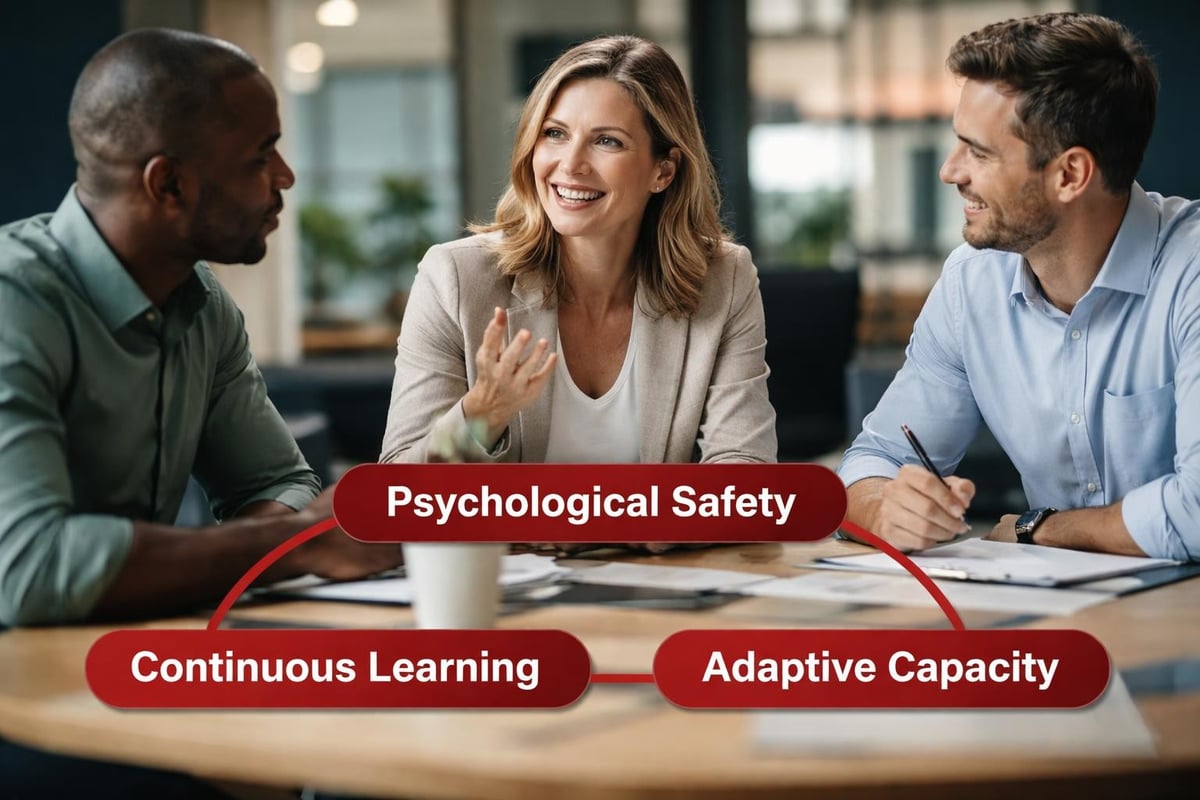
Thrive teams represent more than just groups of talented individuals working together. Building a high-performing team requires deliberate structures that support social connection, continuous learning, and psychological safety. These three pillars create environments where team members contribute their best thinking without fear of negative consequences.
The distinction between functional teams and thrive teams becomes apparent when measuring business outcomes. While functional teams complete assigned tasks, thrive teams identify opportunities, solve complex problems proactively, and adapt quickly to market changes. This difference matters significantly for companies in software, services, and manufacturing sectors where innovation and speed determine competitive advantage.
Thrive teams exhibit specific behaviors and structures that separate them from traditional work groups:
Research from the Thriving Teams Institute demonstrates that teams with these characteristics outperform peers by significant margins across key performance indicators. For revenue-focused organizations, this translates directly to improved conversion rates, faster sales cycles, and enhanced customer retention.
Creating thrive teams requires intentional design rather than hoping talented people will naturally collaborate effectively. Start by examining current team structures, communication patterns, and decision-making processes. Many organizations discover that siloed departments, unclear roles, and outdated workflows prevent teams from reaching their potential.
Traditional organizational charts often create barriers between teams that should collaborate closely. Sales, marketing, customer success, and partnership functions must work as integrated units rather than separate departments. This integration becomes particularly critical when companies face revenue plateaus.
Consider how information flows between teams. Do marketing insights reach sales teams in actionable formats? Does customer success data inform product development priorities? Thrive teams eliminate these gaps through cross-functional collaboration structures.
Key restructuring strategies include:
Some organizations benefit from conducting a comprehensive evaluation of their current team structures and technology stack to identify improvement opportunities. This systematic approach reveals hidden inefficiencies that limit team performance.
Teams cannot thrive when members fear speaking up or making mistakes. Leaders must actively cultivate environments where calculated risks receive support and failures become learning opportunities. This cultural shift often proves challenging for organizations with legacy hierarchical structures.
Psychological safety doesn't mean eliminating accountability or lowering standards. Instead, it creates space for team members to bring their full capabilities to work. When sales professionals can discuss lost deals without blame, marketing teams can test unconventional campaigns, and customer success managers can flag systemic issues, the entire organization benefits from increased transparency.
| Leadership Behavior | Impact on Psychological Safety | Revenue Outcome |
|---|---|---|
| Acknowledging mistakes publicly | Normalizes failure as learning | Faster iteration on strategies |
| Asking questions vs. giving answers | Encourages team problem-solving | More innovative solutions |
| Rewarding constructive dissent | Surfaces important concerns early | Avoids costly mistakes |
| Sharing customer feedback openly | Builds collective understanding | Improved product-market fit |
Thrive teams don't separate learning from execution. They embed skill development, knowledge sharing, and strategic thinking into regular workflows. This integration distinguishes companies that adapt quickly from those that struggle with change.
For software companies, this might mean dedicating time during sprint planning to share competitive intelligence or discuss emerging customer needs. Service businesses could implement peer coaching sessions where team members analyze successful client engagements. Manufacturing organizations might create cross-training programs that build versatility while strengthening team connections.
The challenge lies in making learning sustainable rather than adding extra meetings to already full calendars. Effective approaches weave development into existing processes:
Resources for integrating team learning into daily work help organizations move beyond traditional training programs that often fail to drive behavior change. The most effective learning happens through doing, reflecting, and adjusting based on real business challenges.

Modern collaboration tools can either enhance team performance or create new sources of friction. Thrive teams use technology strategically to reduce administrative burden, improve communication, and surface insights that inform decision-making.
The technology landscape offers countless options for project management, communication, customer relationship management, and data analysis. Rather than adopting tools because competitors use them, thrive teams evaluate technology based on specific needs and workflows.
Critical evaluation criteria include:
Some organizations discover that stress-reducing tools integrated into daily workflows improve team well-being alongside productivity. When team members manage stress effectively, they bring better energy and focus to collaborative work.
The strategic use of AI tools represents a particularly valuable opportunity for revenue-focused organizations. Automation can handle repetitive tasks in sales outreach, marketing content creation, and customer data analysis. This frees team members to focus on high-value activities like relationship building, strategic planning, and creative problem-solving.
What gets measured gets managed, but traditional metrics often fail to capture what makes teams truly effective. Beyond revenue numbers and activity metrics, organizations need indicators that reveal team health and sustainability.
Effective measurement systems combine business outcomes with team process indicators:
| Metric Category | Example Indicators | Why It Matters |
|---|---|---|
| Revenue Performance | Conversion rates, deal velocity, customer lifetime value | Direct business impact |
| Team Learning | Skills acquired, experiments conducted, insights shared | Future capability building |
| Collaboration Quality | Cross-functional projects, knowledge transfer frequency | Integration effectiveness |
| Psychological Safety | Survey scores, participation rates in discussions | Foundation for all other metrics |
| Customer Impact | NPS scores, retention rates, expansion revenue | Ultimate validation of team effectiveness |
Leading indicators deserve particular attention. Rather than only measuring outcomes like closed deals, track activities that predict future success. These might include customer discovery conversations, strategic partnership discussions, or internal knowledge-sharing sessions.

Even organizations committed to building thrive teams encounter predictable challenges. Recognizing these obstacles early allows leaders to address them proactively rather than waiting until performance suffers.
Teams accustomed to working in certain ways often resist restructuring efforts. This resistance typically stems from uncertainty about new roles, fear of reduced influence, or skepticism about whether changes will improve outcomes. Successful transitions require clear communication about why changes matter and how they benefit both the organization and individual team members.
Strategies for managing resistance:
Legacy businesses often face particular challenges when shifting from established hierarchies to more collaborative models. Leaders who think strategically about organizational transformation recognize that culture change requires sustained effort rather than one-time initiatives.
As organizations scale, maintaining the characteristics of thrive teams becomes increasingly difficult. What works for a team of eight people often breaks down at twenty or fifty. Deliberate strategies for preserving team effectiveness through growth separate companies that maintain performance from those that plateau.
Consider how communication patterns change with team size. In small teams, informal conversations keep everyone aligned. Larger teams require more structured communication channels, documentation practices, and decision-making frameworks. The key is adding structure without sacrificing the psychological safety and learning orientation that made smaller teams effective.
Revenue generation rarely results from a single team's efforts. Sales, marketing, customer success, and partnerships must work as integrated units rather than independent functions. Thrive teams understand this interdependence and actively build bridges between departments.
Formal structures that encourage cross-functional collaboration include:
Manufacturing companies often struggle with alignment between production teams and customer-facing functions. When engineering, operations, sales, and support teams share information freely, the organization responds more quickly to market demands and quality issues.
Software businesses face similar challenges when product development becomes disconnected from customer needs. Companies that demonstrate explosive growth typically maintain tight integration between product, sales, and customer success teams throughout their scaling journey.
Individual contributors who excel at their functional roles often struggle when promoted to leadership positions. Building thrive teams requires different capabilities than executing tasks personally. Organizations must invest in developing these leadership competencies deliberately.
Leaders of thrive teams demonstrate specific skills that create conditions for team success:
Programs focused on preparing leaders for modern work environments recognize that traditional management training often overlooks these critical capabilities. The best development combines theoretical frameworks with practical application in real business situations.
Market conditions constantly shift. Customer preferences evolve. Competitive pressures intensify. Technologies disrupt established business models. Thrive teams maintain performance through these changes by building adaptation into their core processes.
Resilient teams don't just react to changes-they anticipate and prepare for them. This requires creating space for strategic thinking alongside tactical execution. Teams entirely focused on hitting this quarter's numbers rarely invest in capabilities that will matter next year.
Practical resilience-building approaches include:
Organizations that integrate comprehensive collaboration strategies into their operational models typically weather disruptions more effectively than those relying solely on individual talent or legacy advantages.
The ability to maintain team thriving during difficult periods separates organizations that emerge stronger from crises from those that struggle to recover. This resilience stems from the psychological safety, continuous learning, and adaptive capacity built during more stable times.
Building thrive teams transforms how organizations approach revenue growth by creating sustainable performance engines rather than relying on individual heroics or market luck. The integration of psychological safety, continuous learning, and strategic collaboration produces teams capable of adapting to challenges while maintaining consistent results. When your organization faces revenue plateaus or needs to accelerate growth, ApetureCodex works alongside your teams to restructure roles, improve processes, and implement strategic changes that unlock your next phase of expansion. Our hands-on approach ensures new strategies translate into measurable revenue improvements across sales, marketing, customer success, and partnerships.


Many executives in Software-as-a-Service (SaaS) companies possess a wealth of technical expertise, operational experience, and industry know-how. Yet, when they step into the boardroom, they often find themselves struggling to make an impact. Why? Because boardrooms don’t operate on the same rules as engineering teams, marketing departments, or product strategy meetings.For many SaaS executives, the inability to gain traction in the boardroom isn’t about a lack of intelligence or hard work—it’s about a fundamental disconnect between their mindset and the expectations of board members, investors, and CEOs. In the fast-moving world of SaaS, where valuation, profitability, and sustainable growth are king, thinking like a functional leader simply isn’t enough. Executives must learn to think like a CEO.This white paper explores the core reasons why SaaS executives often struggle in the boardroom and provides a roadmap for shifting their mindset to operate with the strategic, high-level thinking required to win over investors and board members.