February 27, 2026

Most founders and executives spend their days buried in operational tasks, responding to urgent emails, putting out fires, and managing day-to-day crises. They're working in their business rather than stepping back to work on business development and strategic growth. This distinction, while seemingly subtle, separates companies that plateau at predictable revenue ceilings from those that break through to sustainable, scalable expansion. Understanding how to shift from reactive operations to proactive strategy building represents one of the most critical transitions any business leader can make.
When you work in your business, you're executing tasks that keep operations running. You're closing individual sales deals, handling customer service issues, managing project deliveries, or troubleshooting technical problems. These activities are necessary, but they don't build the systems that allow your company to scale.
To work on business means stepping into the role of architect rather than builder. You're examining your entire operation from a strategic vantage point, identifying bottlenecks, designing repeatable processes, and creating infrastructure that enables growth without proportional increases in your personal time investment.
The difference manifests in several key areas:
The trap of working exclusively in your business develops naturally. Early-stage companies require founders to wear multiple hats, personally handling everything from sales calls to product development. This hands-on approach creates initial success, which then reinforces the behavior pattern.
As revenue grows, the operational demands multiply faster than most leaders anticipate. What worked at $500K in annual revenue becomes unsustainable at $2M, yet the founder continues using the same approach. The business becomes dependent on specific individuals rather than functioning through well-designed systems and processes.
| Revenue Stage | Common Trap | Strategic Need |
|---|---|---|
| $0-$1M | Founder does everything personally | Document core processes |
| $1M-$5M | Hiring without clear roles/systems | Define organizational structure |
| $5M-$20M | Middle management without frameworks | Implement scalable systems |
| $20M+ | Siloed departments, communication gaps | Integrate cross-functional processes |
Many software, services, and manufacturing companies plateau because leadership never makes the transition to strategic thinking. They remain exceptionally skilled operators but fail to develop the organizational architecture necessary for the next growth phase.

The first challenge most leaders face is finding time to work on business when urgent operational matters constantly demand attention. This requires deliberate calendar architecture and boundary setting.
Successful executives systematically protect strategic thinking time. Start by blocking dedicated hours each week specifically for business development work, treating these blocks as non-negotiable appointments. Begin with just three hours weekly if that's all your schedule allows, but defend that time rigorously.
During these strategic blocks, focus exclusively on:
The key is separating this strategic work from operational execution. Don't answer emails, take calls, or handle customer issues during these protected hours. Train your team to handle operational matters independently, which itself represents an important shift toward working on business rather than in it.
You cannot improve what you don't measure. Create a comprehensive dashboard that tracks the metrics truly driving your business growth. Most companies track revenue and expenses but fail to monitor the underlying operational metrics that generate those outcomes.
For software companies, this might include customer acquisition cost, lifetime value, churn rate, feature adoption rates, and support ticket resolution times. Service businesses should track project profitability, capacity utilization, client satisfaction scores, and referral rates. Manufacturing firms need visibility into production efficiency, defect rates, supply chain reliability, and inventory turnover.
Business process improvement methodologies emphasize the importance of baseline measurement before implementing changes. Without clear metrics, you're making strategic decisions based on intuition rather than data.
One of the most impactful ways to work on business involves rethinking how your team is organized and what roles people fill. Many companies grow organically, adding people to handle increased workload without strategically designing organizational structure.
Step back and evaluate whether your current team structure supports your growth objectives. Are people in roles that leverage their strengths? Do you have the right functions represented? Are responsibilities clearly defined, or do overlaps and gaps create inefficiency?
A People and Technology Audit can reveal opportunities for significant improvement by examining how your human capital and technological tools align with strategic goals. This type of assessment identifies where restructuring roles, clarifying functions, or implementing new capabilities could dramatically improve results.
Key questions to address during team optimization:
As you work on business structure, think in terms of functions rather than individuals. What does your organization need to accomplish, and what roles must exist to deliver those outcomes? This functional approach allows you to build an organization that operates effectively regardless of which specific people fill particular positions.
Document each role's responsibilities, success metrics, and required competencies. Create clear reporting structures and decision-making frameworks. This organizational clarity allows you to scale without creating chaos or becoming personally involved in every decision.

Processes represent the operating system of your business. When you work on business processes, you're building infrastructure that allows consistent, predictable results without constant oversight.
Not all processes deserve equal attention. Focus on workflows that directly impact revenue, customer experience, or operational efficiency. Process improvement methodologies like Lean and Six Sigma provide frameworks for systematically identifying and eliminating waste in business operations.
Start by mapping your core processes from end to end. For a software company, this might include your sales process from lead generation through contract signing, your product development cycle from feature conception to release, and your customer onboarding sequence from initial signup through full adoption.
| Process Type | Common Inefficiencies | Improvement Opportunities |
|---|---|---|
| Sales | Manual data entry, inconsistent follow-up | CRM automation, standardized sequences |
| Customer Success | Reactive support, unclear escalation | Proactive monitoring, tiered support structure |
| Product Development | Unclear requirements, scope creep | Structured feedback collection, sprint planning |
| Marketing | Disconnected campaigns, poor attribution | Integrated automation, analytics implementation |
Artificial intelligence and automation tools have transformed what's possible when you work on business optimization. Research shows how SMEs can leverage AI as a strategic growth catalyst, offering frameworks for adoption that dramatically improve efficiency and outcomes.
Consider where repetitive tasks consume valuable time across your organization. Customer service inquiries, data analysis, content creation, scheduling, reporting, and numerous other functions can be partially or fully automated with current technology. This doesn't just save time; it reduces errors and ensures consistency.
High-ROI automation opportunities include:
The key is implementing these tools strategically rather than adopting technology for its own sake. Each automation should solve a specific bottleneck or inefficiency you've identified through your strategic analysis.
Working on business necessarily includes evaluating growth opportunities beyond your current operations. This strategic perspective allows you to identify new markets, partnerships, products, or service lines that align with your capabilities and market demand.
Diversification strategies involve entering new markets or offering new products to reduce risk and drive growth. However, expansion must be strategic rather than opportunistic. Evaluate potential growth directions based on your core competencies, market trends, competitive dynamics, and resource requirements.
For software companies stuck at a revenue plateau, this might mean expanding into adjacent market segments, developing complementary products, or creating new pricing tiers. Service businesses might consider geographic expansion, new service offerings, or vertical specialization. Manufacturing firms could explore new product categories, direct-to-consumer channels, or private label opportunities.
Partnerships represent a powerful but often underutilized growth lever. When you work on business development through strategic alliances, you can access new markets, capabilities, and customer bases without building everything internally.
Identify companies that serve similar customers but offer complementary rather than competing solutions. Structure partnerships that create mutual value, whether through referral agreements, technology integrations, co-marketing initiatives, or revenue-sharing arrangements. Many businesses discover that strategic growth approaches through partnerships accelerate revenue faster than organic expansion alone.
Effective partnership strategies require:
As you shift time and energy toward working on business rather than in it, you need mechanisms to evaluate whether your strategic efforts are generating meaningful results. This requires both leading and lagging indicators.
Leading indicators predict future performance, allowing you to course-correct before problems appear in revenue numbers. These might include pipeline velocity, customer engagement scores, employee productivity metrics, or process cycle times.
For example, if you've redesigned your sales process, track how quickly leads move through each stage, conversion rates at each step, and average deal sizes. If you've implemented new customer success initiatives, monitor usage frequency, feature adoption rates, and satisfaction scores. These leading indicators reveal whether your strategic changes are working before they fully impact financial results.
The most effective approach to work on business involves continuous learning and iteration. Implement regular review cycles where you assess what's working, what isn't, and what needs adjustment. Monthly or quarterly business reviews should examine both operational performance and strategic initiative progress.
Research on business process optimization using AI and analytics demonstrates that organizations combining data-driven insights with continuous improvement achieve significantly better outcomes than those making periodic large changes without feedback loops.
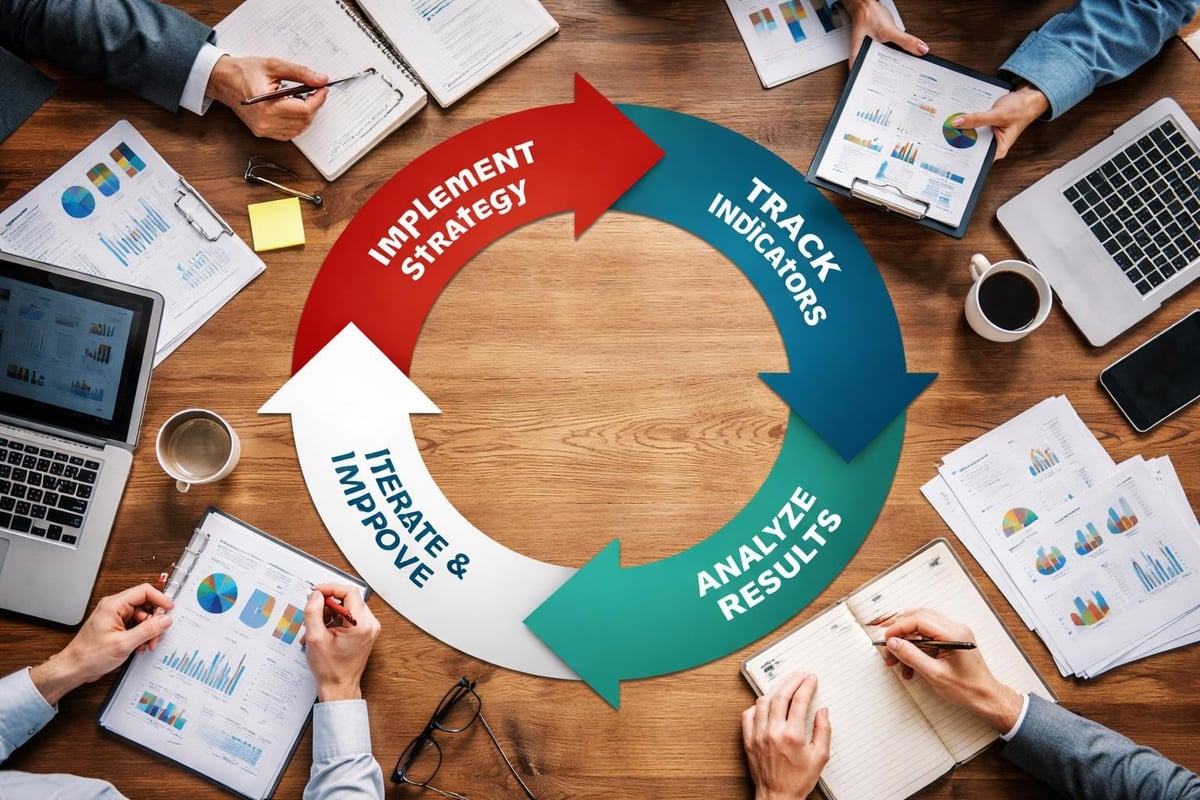
The goal isn't to completely abandon operational involvement but to systematically reduce your personal operational necessity while increasing strategic impact. This balance shifts over time as your systems mature and team capabilities grow.
Most leaders cannot immediately shift from 90% operational work to 90% strategic work. Instead, implement a gradual transition that builds capability progressively. Start by documenting one critical process, training someone else to own it, and monitoring results until you're confident in their independent execution.
A realistic progression might look like:
This gradual approach prevents the chaos that occurs when leaders try to completely disengage from operations before systems and team capabilities are ready to support that transition.
Even as you successfully work on business strategy rather than daily operations, maintain enough operational involvement to stay grounded in reality. Completely disconnecting from customer interactions, team challenges, and market dynamics leads to ivory-tower strategy that doesn't reflect actual conditions.
Schedule regular touchpoints where you directly engage with customers, shadow team members, review support tickets, or participate in delivery work. This keeps your strategic thinking informed by operational reality while not consuming the majority of your time and attention. The principles of growth hacking often emphasize this connection between strategic innovation and practical execution.
The ultimate purpose of working on business rather than in it is creating sustainable competitive advantages that compound over time. These advantages emerge from superior systems, stronger team capabilities, better customer relationships, and more efficient processes than competitors can easily replicate.
Your unique approach to delivering value becomes a moat that protects market position. As you work on business processes, focus on developing methodologies that competitors cannot easily copy because they're integrated across multiple systems and embody accumulated organizational knowledge.
For software companies, this might be a uniquely effective onboarding process that drives faster time-to-value. Service businesses might develop diagnostic frameworks or delivery methodologies that consistently produce superior outcomes. Manufacturing firms could create quality control systems or supply chain relationships that ensure reliability competitors cannot match.
The most sustainable competitive advantages come from organizational capabilities rather than individual heroics. When you successfully work on business development, you're building systems that capture knowledge, train team members, and continuously improve over time.
Document best practices, create training programs, implement peer learning systems, and build communities of practice within your organization. This transforms individual expertise into organizational assets that persist regardless of personnel changes and scale as you grow.
Many companies plateau because they rely on key individuals rather than building knowledge systems. Learning from rapid growth examples reveals how successful companies systematically capture and scale their knowledge as they expand.
Making the transition to work on business rather than in it represents one of the most challenging but rewarding shifts any business leader can undertake. By systematically building processes, optimizing team structure, leveraging technology, and focusing on strategic growth initiatives, you create the foundation for sustainable revenue expansion beyond current plateaus. ApetureCodex specializes in helping software, services, and manufacturing companies break through revenue ceilings by reworking teams, improving processes, and implementing AI-driven solutions that transform operational capabilities into strategic competitive advantages.
Article written using RankPill.


Many executives in Software-as-a-Service (SaaS) companies possess a wealth of technical expertise, operational experience, and industry know-how. Yet, when they step into the boardroom, they often find themselves struggling to make an impact. Why? Because boardrooms don’t operate on the same rules as engineering teams, marketing departments, or product strategy meetings.For many SaaS executives, the inability to gain traction in the boardroom isn’t about a lack of intelligence or hard work—it’s about a fundamental disconnect between their mindset and the expectations of board members, investors, and CEOs. In the fast-moving world of SaaS, where valuation, profitability, and sustainable growth are king, thinking like a functional leader simply isn’t enough. Executives must learn to think like a CEO.This white paper explores the core reasons why SaaS executives often struggle in the boardroom and provides a roadmap for shifting their mindset to operate with the strategic, high-level thinking required to win over investors and board members.


