February 26, 2026

Every business reaches a point where progress stalls, revenue plateaus, and the path forward becomes unclear. This moment of stagnation often reveals a critical gap between current capabilities and future ambitions. Understanding your fundamental company need is the first step toward breaking through revenue ceilings and achieving sustainable growth. Whether you're a startup gaining early traction or a legacy business navigating market shifts, identifying and addressing core organizational needs separates companies that scale from those that stagnate.
The concept of a company need extends far beyond simple wants or desires. It represents the essential gaps, deficiencies, or opportunities that must be addressed to achieve meaningful business objectives. For software companies, this might mean modernizing sales processes to handle enterprise deals. For manufacturing businesses, it could involve implementing partnership strategies to reach new markets. Service organizations often face the company need of improving customer retention systems to maximize lifetime value.

Recognizing these needs requires honest assessment. Many organizations struggle because leadership confuses symptoms with root causes. Declining sales numbers are a symptom. The underlying company need might be an outdated go-to-market strategy, insufficient lead generation, or misaligned compensation structures. Developing a comprehensive business growth strategy demands this level of diagnostic precision.
Most businesses experience predictable growth phases. Initial success comes from founder-led sales, word-of-mouth referrals, or first-mover advantages. But somewhere between $2 million and $20 million in annual revenue, growth slows. The strategies that built the business stop working. This plateau signals a fundamental company need: the requirement to professionalize operations, systematize processes, and scale beyond individual heroics.
Common indicators of this plateau include:
The company need at this stage is structural transformation. Early-stage approaches don't scale. What worked with 10 customers fails with 100. Managing business growth effectively requires acknowledging this reality and making intentional changes to organizational design.
Effective diagnosis begins with data collection across four critical areas: sales performance, marketing efficiency, customer success metrics, and partnership contribution. Each area reveals specific patterns that point toward underlying needs. A People and Technology Audit can systematically evaluate where improvements generate the highest return, examining both human capabilities and technical infrastructure to identify optimization opportunities.
| Assessment Area | Key Metrics | What They Reveal |
|---|---|---|
| Sales Performance | Win rate, cycle length, deal size, quota attainment | Process efficiency, team capability, market fit |
| Marketing Efficiency | Cost per lead, conversion rates, channel ROI | Message-market alignment, audience targeting |
| Customer Success | Retention rate, expansion revenue, NPS, support tickets | Product value delivery, onboarding effectiveness |
| Partnership Impact | Revenue contribution, deal registration, co-selling activity | Channel health, partner engagement |
Sales analysis uncovers whether your company need centers on process, people, or positioning. Low win rates combined with high activity suggest targeting or qualification issues. Long sales cycles with strong close rates indicate negotiation or procurement friction. These patterns guide strategic intervention.
Marketing metrics reveal different needs. High lead volume with poor conversion points to lead quality problems or sales-marketing misalignment. Low traffic but strong conversion suggests awareness gaps. The company need might be refining ideal customer profiles, improving content relevance, or expanding channel mix.
Technology receives significant attention in business transformation discussions, yet the company need often lies in human capital development. Skills gaps, unclear roles, and misaligned incentives create more friction than outdated software. Teams structured for previous revenue stages struggle when market demands evolve.
Consider a manufacturing company that grew through direct sales relationships. As they pursue larger contracts requiring RFP responses and committee selling, the company need shifts from relationship skills to technical selling capabilities. The existing team excels at building trust but lacks experience navigating complex procurement processes.
This systematic approach ensures that addressing the company need produces measurable results rather than superficial changes. Strategic approaches to business expansion consistently emphasize aligning human capital with growth objectives.
Once diagnostic work identifies the primary company need, selecting the appropriate strategic framework becomes critical. Different situations require different approaches. A market penetration need demands different tactics than a diversification need. Understanding these frameworks helps leaders make informed decisions about resource allocation.
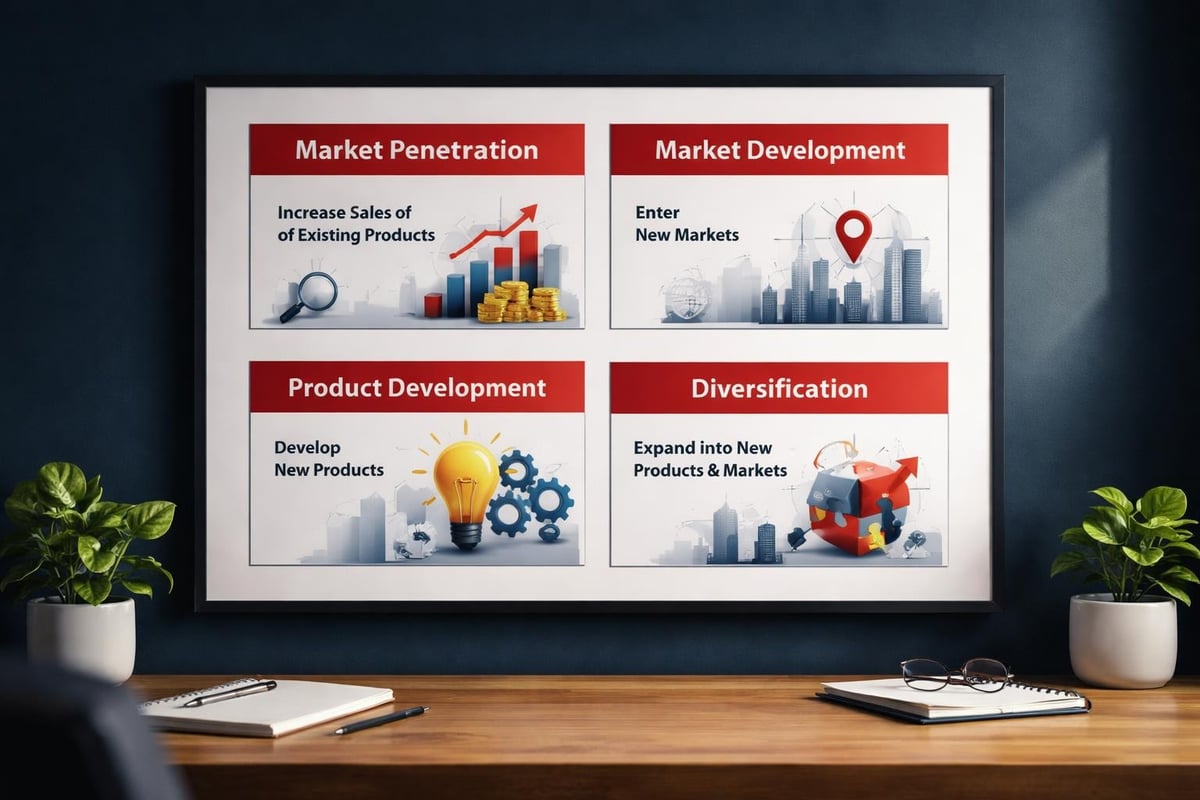
When the company need involves capturing greater market share within existing segments, penetration strategies prove most effective. This approach works when market research shows significant untapped potential among current customer types. The focus shifts to improving conversion rates, increasing purchase frequency, and winning competitive conversions.
Penetration tactics include:
Service companies often face this company need when competitors enter their space. The solution isn't always differentiation through new offerings. Sometimes the answer lies in executing existing strategies more effectively than competitors. Growth through existing customer engagement can drive significant revenue increases without requiring new market development.
Alternative scenarios present a different company need: accessing new customer segments or geographic markets with existing solutions. This strategy suits businesses with proven product-market fit seeking expansion paths. The challenge centers on adapting go-to-market approaches for unfamiliar audiences.
A software company serving small businesses might identify enterprise readiness as their primary company need. The product satisfies requirements, but sales processes, support infrastructure, and marketing messages require adaptation. Success demands understanding how enterprise buyers differ from SMB buyers in evaluation criteria, decision timelines, and success metrics.
Many organizations overlook operational improvement when considering growth strategies. Yet operational excellence directly addresses a common company need: doing more with existing resources. Efficiency gains compound over time, creating sustainable competitive advantages that fuel long-term growth.
Process optimization in sales functions can increase rep productivity by 20-30% without hiring additional headcount. Marketing automation properly implemented reduces cost per acquisition while improving lead quality. Customer success systematization enables each manager to handle larger portfolios without sacrificing retention rates.
| Operational Area | Efficiency Opportunity | Typical Impact |
|---|---|---|
| Sales Operations | CRM optimization, proposal automation, pipeline management | 15-25% productivity increase |
| Marketing Operations | Campaign automation, lead scoring, attribution modeling | 20-35% cost reduction |
| Customer Success | Health monitoring, expansion playbooks, onboarding sequences | 10-20% retention improvement |
| Partnership Management | Deal registration systems, co-marketing automation, training portals | 25-40% partner revenue increase |
The company need for operational excellence intensifies as organizations scale. Manual processes that worked with 10 deals monthly break down at 100 deals monthly. AI tools and modern automation platforms enable small teams to handle enterprise-scale operations. Exploring modern growth strategies reveals how technology multiplies human capabilities when thoughtfully implemented.
Artificial intelligence represents a transformative response to the company need for scalability. Forward-thinking organizations deploy AI across multiple functions: lead qualification, content personalization, forecasting, customer sentiment analysis, and competitive intelligence. These applications don't replace human judgment but amplify it.
Sales teams using AI-powered conversation intelligence identify winning behaviors faster than traditional coaching allows. Marketing teams leverage predictive analytics to allocate budget toward highest-performing channels. Customer success managers receive proactive alerts about at-risk accounts before churn indicators appear in traditional metrics.
The implementation challenge isn't technical complexity but change management. Teams accustomed to intuition-based decision making resist data-driven approaches. Addressing this company need requires training, patience, and demonstrating quick wins that build confidence in new methodologies.
Revenue growth doesn't always require new customer acquisition. Existing customers represent the most overlooked growth opportunity for many businesses. The company need often centers on maximizing customer lifetime value through expansion, upselling, and preventing churn. This approach delivers higher margins and more predictable revenue than constantly filling a leaky bucket with new logos.

Implementing diverse growth strategies often starts with customer base analysis. Data reveals segments with expansion potential, identifies common success patterns, and highlights risk factors predicting churn. This intelligence informs where to focus retention and expansion efforts.
Customer expansion tactics:
Manufacturing companies discover the company need for customer-centricity when commodity competition intensifies. Differentiating on product alone becomes impossible. Value shifts to total cost of ownership, partnership depth, and innovation collaboration. Companies that master these dimensions command premium pricing despite competitive markets.
Strategic partnerships address a specific company need: accessing markets, capabilities, or credibility that would take years to build independently. Technology companies partner with implementation consultancies to reach enterprise buyers. Service firms partner with complementary providers to offer complete solutions. Manufacturing businesses partner with distributors to penetrate regional markets.
Successful partnerships require structural thinking beyond handshake agreements. The company need extends to formal partner programs with clear economics, enablement resources, and joint success metrics. Strategic partnership development creates multiplier effects when partners become authentic extensions of your go-to-market engine.
Lessons from successful growth trajectories, such as those demonstrated by fast-growing SaaS companies, show that partnership strategies excel when they align with core company strengths rather than compensate for weaknesses. Partners amplify what you do well; they rarely fix fundamental deficiencies.
Defining the company need is meaningless without measurement frameworks that track progress. Objectives require translation into key results with specific timelines, ownership, and milestones. This discipline ensures accountability and enables course correction when initiatives underperform.
Effective measurement practices include:
Revenue growth rarely follows linear paths. Markets shift, competitors respond, and internal challenges emerge. The company need that seemed clear in January may require refinement by June. Measurement systems that track both outcomes and leading indicators provide early warning when strategies need adjustment.
Software companies often discover their company need evolves as they scale. Initial needs center on product-market fit and early sales motion. Growth-stage needs shift to scaling go-to-market and operational efficiency. Mature-stage needs focus on market expansion and innovation. Measurement frameworks must adapt to these changing priorities while maintaining consistency in core metrics.
Addressing any significant company need requires organizational change capability. Some businesses excel at identifying needs but struggle with implementation. Others move quickly but fail to sustain improvements. Building systematic change capacity becomes a meta-need that enables addressing all other needs more effectively.
Change capacity depends on several factors: leadership alignment, communication effectiveness, resource allocation discipline, and cultural openness to evolution. Organizations with strong change muscles treat transformation as a capability to develop rather than a one-time event. They invest in project management skills, train employees on new systems, and create feedback mechanisms that catch implementation problems early.
The company need for change capacity intensifies in industries experiencing disruption. Legacy businesses competing against digital-native startups must transform faster than market conditions evolve. This pressure creates urgency but also increases risk of misguided initiatives that waste resources without generating results.
Understanding your company need provides the foundation for breaking through revenue plateaus and achieving sustainable growth. Whether the challenge lies in sales effectiveness, marketing efficiency, customer retention, or partnership development, diagnostic precision enables targeted intervention that generates measurable results. If your organization has been stuck at a certain revenue level and traditional approaches aren't delivering breakthrough results, ApetureCodex specializes in identifying core business needs and implementing comprehensive solutions across sales, marketing, customer success, and partnerships to unlock your next phase of profitable growth.
Article written using RankPill.


HockeyStack has quickly become one of the fastest-growing SaaS startups, securing $20M in funding and redefining how B2B companies approach analytics. But what exactly did they do right? This article breaks down five key lessons SaaS founders can learn from HockeyStack’s success, including how they owned a critical market gap, leveraged AI agents, built a demand-generation engine, mastered community-led growth, and secured smart funding. If you're looking to scale your SaaS startup the right way, these insights will help you move faster and avoid common pitfalls.

Many executives in Software-as-a-Service (SaaS) companies possess a wealth of technical expertise, operational experience, and industry know-how. Yet, when they step into the boardroom, they often find themselves struggling to make an impact. Why? Because boardrooms don’t operate on the same rules as engineering teams, marketing departments, or product strategy meetings.For many SaaS executives, the inability to gain traction in the boardroom isn’t about a lack of intelligence or hard work—it’s about a fundamental disconnect between their mindset and the expectations of board members, investors, and CEOs. In the fast-moving world of SaaS, where valuation, profitability, and sustainable growth are king, thinking like a functional leader simply isn’t enough. Executives must learn to think like a CEO.This white paper explores the core reasons why SaaS executives often struggle in the boardroom and provides a roadmap for shifting their mindset to operate with the strategic, high-level thinking required to win over investors and board members.

